July 29, 2011

It's a Matter of Trust..and Patience

I have discovered that it is very easy to talk about trusting God, but a bit more difficult to put it into practice. Last week I wrote that I was having several medical tests.  Well, in addition to the high cholesterol, I just found that that my sonogram showed something that is potentially serious. Of course they don't tell you anything over the phone so I started to worry and after looking the condition up on the internet my mind started expecting the worst.  I decided the best thing to do was go down to the beach to walk and pray.  It was there that I realized that I have to put my money where my mouth is so to speak. I talk about trust in the Lord, now I have to do it, put all my trust in Him, no matter what the outcome.
Sunset at Jones Beach

As I was walking over the sand at sunset, I sensed a calm come over me.  I recall walking on the beach several years ago during a rough time, and "hearing" the Lord tell me that I have much more to suffer. I sort of shrugged it off, but last night those words came back to me.  Yet, what also came back to me were the words of St. Therese in one of her poems. This great saint totally embraced her suffering, giving it all to Jesus, and trusting in His Love for her.

If sometimes bitter suffering
Should come to visit your            heart,
Make it your joy:
To suffer for God...                     what sweetness!...
Then Divine tenderness
Will make you soon forget
That you walk on thorns
Well, I'm not a saint, and I don't think I can easily get to the point that Therese got with regard to her suffering and illness. But I can learn from her.  Her Love for God put her pain and suffering in the proper perspective.  I am praying that I will find out that I really don't have anything too seriously wrong, but I will have to be patient in finding out since I could not get a follow up appointment until the end of August.  Patience is a virtue that is almost as difficult to achieve as trust.  But, it is a Fruit of the Holy Spirit so perhaps God is asking me to pray my favorite novena, the Novena to the Holy Spirit.  Prayer is a better way to deal with situations like this rather than getting anxious any day.

July 21, 2011

Diet and Exercise

My annual medical checkup had been almost two years ago so I thought with summer kind of slow it is a good time to schedule appointments with my various doctors.  This week I had two doctor appointments for physicals, a complete blood workup, an EKG, and a bone density evaluation. Two weeks ago I had a mammogram, and next week I have to go for a sonogram.  So far everything seems fine except for one thing, my cholesterol is 235.  The doctor wants it to be 185. The good thing is that my HDL and triglycerides are good, but I still have to lower that LDL.  She said I need to lose weight (yes, I know that), stop eating animal fats, and get plenty of exercise. Also, to keep my bones healthy she wants me to lift weights and walk.

I took the news in stride, but when I got home I realized that means no burgers on the grill, and the sausage and peppers I made the other night will have to be eaten by someone else.  I'm not a big red meat fan, but the fact that I am now called to avoid it makes me feel deprived. As for exercise, well, I have weights just sitting in the corner of my room, and the 4 mile boardwalk, which is delightful to walk, is only a 10 minute drive away.  I guess it's time to make some changes and pay attention to diet and exercise to keep healthy. The truth is, when I don't pay attention to these things that might not be good for me, my body lets me know its time to start paying attention or pay the price of getting sick. 

This evening while meditating, I was reflecting on what the doctor ordered and started to think about my spiritual health.  My spiritual side also needs an occasional checkup and "diet and exercise" to keep it healthy and to help  me advance toward the goal of union with God. What kind of diet and exercise do I need?  Well, just as what I eat will have an affect my physical health, I have to ask myself what I let enter my soul that I really should be avoiding, and what should I be doing to keep a healthy spiritual life? What is my spiritual diet? The word diet is derived from the Greek word diaita, which means "a way of life." A healthy spirituality means following a way of life that is centered on Christ and on the Sacraments, especially the Eucharist.  Diet also derives from a Latin word dieta, which means "a days work." Being a Christian is work, more often than not. But what is the "work" of a Christian?  The work of a Christian is to continue the mission of Christ in this world, and to follow the will of God in all things. This calls for a steady diet of prayer, scripture, sacraments and avoiding those temptations that lead me to sin and away from God.

So how to we sustain this way of life? Here is where the exercise comes in.  All the great saints have engaged in any number of spiritual exercises.  Prayer is first on the list, in fact for a healthy spiritual life prayer is essential.  How do I pray?  It is simply routine or do I really communicate with God? These are important questions. I  also include some sort of meditation and spiritual reading as part of my daily spiritual exercise.   I know as a Benedictine Oblate I really should be engaging in Lectio Divina daily, but just as I make excuses against going for that walk on the boardwalk, I often find all sorts of excuses not to engage in Lectio. Acts of popular piety are also on the excercise list. Today many people reject some of these acts as old fashioned or not for them, but many traditional acts of piety such as the Rosary, chaplets, time spent in adoration, novenas, and dedication to particular saints, are ways to deepen our spiritual life.  Regular celebration of the Sacrament of Penance and confiding in a spiritual director or a close spiritual friend (in Celtic spirituality this is called anam cara), are good ways of being assured that I am on the right track in my spiritual journey as long as, like with my medical doctors, I give heed to the advice I am given. Having a prayer partner or having a Christian community to pray with helps keep me focused and accountable.

What happens when I don't stick to a diet and exercise routine? I gain weight, feel sluggish and put my body at risk for illness. What happens when I don't stick to a spiritual diet and exercise routine? I don't know about you, but I usually can tell that my life is out of sorts. I don't have enough patience, it seems that things start to go wrong, and I get restless and anxious. It also pulls me away from what I need to do to grow in my relationship with God. In other words, it keeps me from being open to God's Grace. So here we are in mid summer and I have been pointed on a way to good health physically and spiritually.  The important thing is to now stick to it!

July 20, 2011

St. Apollinaris and Ravenna


Basilicia of Saint'Appollinare
in Classe

 Today being the memorial of St. Apollinaris, I am posting some pictures of the two of the churches named for St. Apollinaris in the city of Ravenna, Italy.  In 1999, while on a trip to Italy with my mom, we had the opportunity to visit these churches and view their magnificent mosaics. It is off the beaten path so it is not a popular tourist stop, but a must for anyone who is an art lover and interested in the almost lost art of mosaics. There are eight places in Ravenna listed as UNESCO World Heritage sites. Ravenna was the capital city of the Western Roman Empire in the 5th century, and was greatly influenced by the Byzantine when in the 6th century Emperor Justinian I made Ravenna the seat of the Byzantine Empire in Italy.


Saint'Apollinarius Nuova

There are two basilicas named for St. Apollinarius, a  bishop and martyr who tradition states was appointed by as bishop of Ravenna by St. Peter himself.  The basilicas of Saint'Apollinare in Classe and Saint'Apollinare Nuovo are both in the Romanesque style but their mosaics are Byzantine.  

The following  are from Saint'Apollinarius in Classe.

St. Apollinaris


Baptism of Jesus


Apse

Interior of the basilica


The following are from Saint'Apollinarius Nuovo. The mosaics on the sides of the nave are male and female martyrs facing toward the sanctuary. We know this because they are carrying the crowns of martyrdom.

Nave of Saint'Apollinarius Nuovo

female martyrs

male martyrs


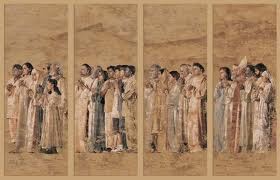
These particular mosics came to mind immediatly when I first walked into the Cathedral of Our Lady of the Angels in Los Angeles and saw the magnificent tapestries that line the walls of the nave. 


Despite the Cathedral being ultra modern in design, the tapestries show the influence of early Church art.  As I have posted previously, I think we have lost something in today's modern world with regard to great relious art.  Religious art was meant to catechize people and to lift their hearts to God.  I think the mosaics of Ravenna are fine examples and I wish I had more room here to explore further the art work in these beautiful churches. If you are ever in Italy, it is worth the trip to see these and the other historic places in Ravenna.

July 18, 2011

Taking Another Look at Confession - part II

When I talk about the Sacrament of Penance in RCIA or in adult catechesis classes, I often hear the question, "Why should I confess my sins to another person?"  That's a valid question.  But if you think about it, most of us engage in some sort of "confession" all the time, we just don't think of it in the same way as we do celebrating the Sacrament with a priest.  How many of us have a friend or confident to whom we confide our deepest secrets?  How many are in or have gone through therapy sessions? Talk to a bartender, hairdresser, or barber about how many "confessions" they have heard while serving drinks or cutting hair. There are plenty of "confessions" done over the internet.  I freqent a Catholic website and I can't beleive how many people write asking for advice about how to deal with a particular sin or vice they have committed (sometimes with a bit too much detail). Then look at television.  Some of the shows with the highest ratings , like Oprah, often have people on who reveal the wrongs they have done on national TV without batting an eyelash.  There is a saying that "confession is good for the soul," and another that states, "we are only as sick as our secrets."  I believe both are true.  Deep down inside we have a need to tell someone what it is that we have done wrong.  Many criminals are caught because they just can't keep what they did secret, and they tell someone who eventually reports it to the police.  So why is it, that in a world where almost no one keeps secret what we do and what we don't do, is confessing to a priest so uncomfortable?

I think a lot has to do with guilt, or lack of it. If we don't sense that we are really doing something wrong then it is no big deal to tell others about it in the situations I mentioned above.  But, when going to confession, I have to admit that, yes, what I did or am doing is  wrong, it is sinful, and  that I am want  to stop doing it because it offends God (I beleive this is a major stubbling block for some). Carrying the weight of guilt and the anxiety of sin and offending God is a great burden to bear. But some people would rather carry that weight than have God lift it from them. Admitting our sins to a priest is a humbling experience, and it seems that today humility is looked down upon as a weakness. St. Benedict's fifth step of humility in the Holy Rule is to confess our sins.  In Twelve Step programs, steps 4 through 10 speak of humbly acknowledging, confessing and making amends for our wrongs (sounds like confession to me). Humility leads to self-knowledge and to a right relationship with God and others, which leads to healing and growth. In celebrating the Sacrament the burden is lifted.

When I explain it in this way, I think it makes a lot of sense to some people.  Sure I explain the theological reasons and the grace of the Sacrament, but for those with "high anxiety" over celebrating this Sacrament, appealing to simple logic seems to be a good start. 

July 17, 2011

Taking Another Look at Confession - part I

Over this past week the subject of Confession has caught my attention in several different ways.   On July 24th, the Congregation for Clergy released a document for priests titled "The Priest Minister of Divine Mercy: an Aid for Confessors and Spiritual Directors, which I took the time to read.  Although it was meant for priests, it gave great insight into the Sacrament. In the book I am currently reading,"Rediscover Catholicism" a Spiritual Guide to Living with Passion & Purpose," by Matthew Kelly, I was up to the chapter titled Confession. To go even further, in an online discussion I was engaged in, the conversation centered around the Sacrament of Penance.  Was God trying to tell me something?  It's only been about two weeks since my last confession, so I don't think that was it.  Perphaps God is asking me to write about it. 

I must admit, celebrating the Sacrament of Reconciliation, Penance, or Confession (what ever one cares to call it), is something that has caught my attention over the last twenty years, especially since I began studying theology.  If fact, I chose it as my ad libitum topic for my comprehensive exams at Notre Dame.  I have been fascinated by the history and development of the Sacrament and also the obvious decline in its celebration among Catholics today (although I think we are seeing a slight increase).  I also feel that it is a Sacrament that is much needed in today's world.  But I didn't always feel that way.

As a child I went to Confession every few weeks, but a bad experience with a priest in confession as an adolescent instilled a fear that stayed with me for years (and to some extent still rears its head at times).  I did still go, but over time it went from months to years between confessions. Also, I gave in to the mistaken notion that if I didn't commit a mortal sin then I didn't need to celebrate the Sacrament. That's what it might appear to say in Canon Law, but what I discovered is that my conscience formation was a bit flawed, and I also gave into a bit of relativism (OK maybe more than a bit), so that I had myself convinced that I really wasn't sinning mortally so I didn't need confession. But God was working on convincing me that this Sacrament was necessary, whether I commit mortal sins or not. When I finally came back to Confession after an absense of 9 years, I still did not feel that great about it, but made it a yearly "gotta do" kind of thing, until I started studying theology, reading about the saints, and looking into enriching my own spiritual life.

What I discovered is that this Sacrament is a beautiful encounter with Jesus, who is loving, forgiving and merciful. It is, writes Kelly, "the perfect spiritual practice to rekindle our passion for excellence in the spiriutal life."  What made ordinary people great saints?  I believe it was the realization that they were sinners and that they believed in God's mercy and accepted His Grace, becoming all that God called them be.  Look at some of our most beloved saints, Paul, Augustine, Francis, Ignatius, they all had less than perfect lives before they encountered Christ.  But, in being open to Grace, they confessed their sinful ways, abandoned their way of life, and drew close to God.

Broken Trust
by Natalie Holland
Taking that step to be open to and accepting of God's Grace requires trust. Perhaps that is another reason why I stayed away from the Sacrament for so long, having been hurt, I was unable to allow myself to trust. What I failed to realize however, was that my lack of trust was based on the fault of a human being, not on God. I let one priest, who was unable to be compassionate to an eleven year old girl, influence my relationship with Christ, who is full of compassion. I allowed one man to affect my trust in God. I wonder how many people have let a bad confession experience keep them away from our Lord's forgiveness and mercy? It took me a long time to rebuild that trust by finding good confessors and availing myself of the Sacrament regularly so that I can keep building my trust in God by experiencing His Love and Forgiveness. Have you been away from the Sacrament for awhile, for one reason or another? Why not take another look at Confession!


July 14, 2011

Feasts, Feathers, and Tom

Today is the memorial of Blessed Kateri Tekakwitha.  Kateri was a Mohawk Indian born near Auriesville, NY in 1656.  She became a Catholic at the age of 20, relocated to Canada, and devoted herself to prayer and the Eucharist. She died at the age of 24 in 1680.  She was the first Native American to be declared Blessed and has been called "the Lily of the Mohawks."

History has painted a pretty awful picture of Native Americans. While I do not deny that there was much violence against European settlers, and especially against priests and religious, it is also true that these were a very spiritual people who had a deep respect for creation and their traditions. When I was doing graduate work in education, I took a history methods course and the prof was very much into Native American history, especially their spirituality. While we as Catholics tend to dismiss Native spirituality as pantheism, there is something we can learn from it...respect for God's creation, adherence to tradition, and the importance of ritual celebration.

Speaking of ritual, the memorial of Blessed Kateri brings back memories of my summers at Notre Dame and one of my classmates named Tom. Tom is the kind of person who makes being Catholic fun!  Some of the things Tom did or said might have bordered on the irreverent, but if you know Tom, you know his love for Christ and for the Church.  What does Tom have to do with Kateri, or ritual?  Well, when we were at Notre Dame, Morning Prayer was celebrated for the students every weekday before class in Our Lady's Chapel. It was an intimate setting where usually just a handful of liturgy students and profs would antiphonally chant or sing Morning Praise. Kateri's feast day seemed to be one of Tom's favorites, or was it just that the hymn they would always choose to sing that morning seemed to have an Indian tom tom (no pun intended) beat.  Tom is good at making up alternate lyrics for hymns, and as I recall he came up with some good ones for Kateri (always presented to us after prayer as we walked to class).  Tom knew the power of humor, and never a day went by when Tom would have us in stitches as we sat around the table in the South Dining Hall (which is reminiscent of Hogwarts main hall, complete with a portrait of Dumbledore at one end - actually it was Fr. Sorin but the beard made the likeness unmistakable).  Study evenings in the dorm were often filled with laughter and silliness at break time.  Working on a class project with him for Ritual Studies didn't seem like work at all (we explored "strange new worlds"and decided that birds must live in the basilica). Tom showed us how not to get anxious over our studies, helped us to relax, and not take ourselves too seriously.

One year, on the feast of Kateri, I took a morning walk by St. Mary's Lake before prayer, something I never did since it was hard enough to get up early to even make it to prayer.  As I was walking I found a feather. Finding a feather is no big deal considering the duck, swan and goose population around the lakes, but it made me think of Kateri, and of Tom.  I brought the feather to the basilica and presented it to Tom before prayer as a gift in honor of Kateri.  Tom put it in his hair and wore it.  He wasn't trying to be funny, at least it didn't seem like it.  He was truly grateful for this simple gift. I hope he realizes what a gift he was to us during those summers. 

Humor is a great gift from God.  It helps to lighten our load, brighten our day, and see things from a different perspective when it is done to build up and not break down.  So often today humor is used as a way to make fun of people, to put them down, to criticize, and to tear apart. The Church often bears the brunt of jokes and degrading humor. I will always be grateful for Tom's contribution of good humor during my time of study, as I have so many stories of how Tom lightened my load and those of my classmates.  

So lighten up! As we celebrate Kateri's feast day, spend some time outside honoring God's creation (she is one of the patrons of the environment).  If you happen to come across a feather, well maybe Kateri is smiling on you.  And Tom, if you still have that feather I gave you, take it out and know that I am thinking of you, blessing you for your humor, and hearing the sound of tom toms.


July 13, 2011

"I will be with you."

It amazes me sometimes how God lets me know when He is trying to get something across to me.  This morning, as I usually do before Mass, I was meditating on the scripture readings for the day.  In the first reading from Exodus (Ex. 3:1-6,9-12), God appears to Moses in the burning bush and tells Moses  to go to Pharaoh and lead the Hebrews out of Egypt. Moses protests saying, "Who am I that I should go...?" I was thinking, how many times in Scripture do we hear that argument, or one like it,  in response to the call of God?  I know Isaiah and Jerimiah both expressed it. So did Peter, and Paul, and many of the saints throughout our history. God calls the most unlikely people to do His work.; people who are too young, too old, cannot speak well, are afraid, don't feel up to the challenge, or simply don't want to or think they can't do what God is asking of them.

My meditation led me to reflect on my own faith journey and how God called me into ministry.  The first time I was called upon to give a talk for a retreat, I really felt frightened and anxious. While I was a teacher and had spoken in public before, this was different.  This was about my faith and I was being asked to call others to faith through the words I was speaking.  Before I was to speak, someone opened the Bible and read from Jeremiah (1:4-9)
"The word of the LORD came to me thus:
Before I formed you in the womb I knew you,
before you were born I dedicated you,
a prophet to the nations I appointed you.
"Ah, Lord GOD!" I said,
"I know not how to speak; I am too young."
But the LORD answered me,
Say not, "I am too young."
To whomever I send you, you shall go;
whatever I command you, you shall speak.
Have no fear before them,
because I am with you to deliver you, says the LORD.
Then the LORD extended his hand and touched my mouth, saying,
See, I place my words in your mouth! "
Wow, did those words speak to me, and a whole new world was opened up. 

Mass began, and when it came to the homily it was about Moses reaction to God's call and how often we say to God, "Who am I that I should go...", or do, or say, or be something that is beyond what we ever thought possible. Father said that when God calls us, He gives us the Grace to see through to completion what He is asking of us.  I took this as a confirmation of my own meditation, but also as a reminder that I need to trust in God and be willing to answer His call, whenever that may come, and to do whatever God asks of me. 

The priest also made reference to the Gospel (Mt.11:25-27) and said that we have to have "childlike" trust. Somewhere in our "growing up" we tend to lose that trusting demeanor. Perhaps it is because the world is so untrustworthy that we carry that over to our faith life.  Perhaps the problems in the Church of late have caused people to lose trust. Yet, we have to remember that the Church is more than simply the people in it, that there is a Divine dimension to the Church that many overlook.  If we have faith in God, we must have trust that God will not lead His Church or us down the wrong path.

My meditation today, and the words of the homily, remind me to have childlike trust and be willing to believe that if God asks something of me it is because He knows that I will be able to do it with His Grace. I know that God will be with me, just as He promised Moses. God will give me what I need to carry it through. All I need to say is "Here I am."