Showing posts with label Mary. Show all posts

February 11, 2012

Our Lady of Lourdes


The Grotto


I have never been to Lourdes, although I hope to be able to go there one day. However, one of my favorite places is the Lourdes Grotto at the University of Notre Dame.  During the three weeks each of the five summers that I spent there studying liturgy, I would spend time at the Grotto almost every day.  It is a man made facsimile of the Grotto at Lourdes and even has a rock from Lourdes imbedded in the wall just below the statue of Mary.  It is a peaceful place, especially in the summer, but there always someone there praying the rosary, lighting a candle, taking pictures or just sitting on a bench reflecting or reading.

I always made the Grotto the last stop after my evening walk around the lakes.  The glow of the candles helped me to reflect on the many prayers that were being offered on behalf of so many people in need, and my needs as well to get through the grueling course of study and writing of papers. The evening before my written comps, after Evening Prayer, I wandered over there and ran into one of my classmates there for the same reason, to ask our Blessed Mother to calm our fears and help us to focus during the four hour exam.  On the day of my oral comps I woke up extra early to stop by and say a prayer.

Being at Our Lady's university those summers was a special time for me. The fact that Mary watches over the campus from her vantage point on top of the Golden Dome was inspiring and reassured me  that she was watching over me as well.  I have to remind myself time after time that Our Lady watches over me all the time, even when I am not aware of her presence.  Mary's is a quiet peaceful presence. While I guess it would be amazing if like Bernadette, I was to come face to face with her, I feel that simply knowing by faith that she is there is amazing as well. As St. Peter said of faith in Jesus,
Although you have not seen him you love him; even though you do not see him now yet believe in him, you rejoice with an indescribable and glorious joy...(1 Peter 1:8)
The same can be said about faith and veneration of our Blessed Lady. Mary appears so that she can lead us to Jesus. Like a loving mother, she guides us in the ways of righteousness and truth. So yes, I would like to go to Lourdes some day, hopefully before I get too old to make the trip.  But, in the meantime, I have my faith in her love and her presence and the knowledge that just like at Notre Dame, even without a dome, she is watching over me...and that brings me joy.

December 20, 2011

Mary said to the Angel, I am the handmaid of the Lord.

I love the readings of this last week before Christmas, especially the Gospels. Today we again hear the story of the Annunciation that we heard on Sunday.  So many great artists have painted the Annunciation and I was happy to find this beautiful collage of such artistic depictions presented along with Hans Leo Hassler's Dixit Maria.  I loved singing this beautiful piece when I was in choir. I hope it helps lead your meditation these final days and brings you joy and peace. (just ignore the clapping at the end).

December 11, 2011

The Moon and Mary


This afternoon I attended our monthly Oblate meeting at St. Walburga Monastery in New Jersey.  We were treated to a presentation on the necessity of leisure and living in the present. A major part of the presentation was on awareness.  Part of living in the present is "being mindfully aware of our surroundings," Sister said, and how "God makes Himself known" through our encounters with God's creation. Awareness helps us remember "that God is God and we are not." On my drive home following evening prayer, while driving over the Goethals Bridge which connects New Jersey with Staten Island, I noticed the full moon, and was very aware of it off to my left as I traveled on the Staten Island Expressway. Once as the road veered off to the East the moon was clearly seen through the left side my front windshield.  As I was watching the moon (and watching the road) I had an understanding of what sister was speaking about.

It was not just the beauty of the moon that attracted me, but I recalled a quote that I heard earlier during our RCIA session.  I had showed one of the episodes of Fr Robert Barron's spectacular documentary series Catholicism.  It was the episode on the Blessed Mother. I showed this episode because of the feast of the Immaculate Conception last Thursday and tomorrow's feast of Our Lady of Guadalupe.  In the video, Fr Barron quotes Archbishop Fulton Sheen who said, "Mary is like the moon, for her light is always a reflection of a higher light."  

I was hoping that as I crossed the Verrazano Bridge into Brooklyn that I would see the beauty of the moon reflected in New York Harbor but then realized that I was heading in the wrong direction for that to occur.  Yet the Lord had other ideas.  As I drove through the plaza and onto the bridge, there was the moon, precisely in the center of the bridge uprights.  It appeared as if I were driving directly into the moon. For once I wished there was stop and go traffic on the bridge (as there often is) so that I could snap a picture with my phone, but that wasn't happening.  I lost sight of it for a few moments as I approached the high point of the span but then it was visible again for the final three quarters of a mile before I turned off the bridge.

The image that was coming to me all this time on the bridge was that Mary, the bright reflected light of Jesus, was leading me toward her Son.  But she was not only the moon light guiding me, but the bridge between heaven and earth.  Assumed into heaven, she alone experiences what awaits us at the resurrection of our bodies at the end of time.  As Fr. Barron states, she "becomes a sign of hope for the rest of the human race."

So was it coincidence that I chose to show the DVD this morning where the image of Mary as the moon was presented and that  the moon was just a day past full? Was it a coincidence that this afternoon's talk was about awareness of God's presence in our surroundings?  And, was it a coincidence that the moon just happened to be between the bridge uprights as I was traversing the span?  Coincidences?  Maybe, but I think not.  God had something to share with me and at any other time, if I was less aware, I just might have missed it.

October 31, 2011

Broken

I broke a statue of our Blessed Mother on Saturday.  It wasn't just any statue as it was given to me as a gift for being in the choir when I was in fourth grade.  That was 48 years ago.  The statue has occupied a place of honor for all those years. First it was on my dresser in my bedroom where I would create an altar around her and crown her with flowers and have her hold my rosaries.  When we moved from Brooklyn she came with us to Long Island and found a place in my room along with pictures of the latest teen idol and a growing collection of records (remember those?).  When I married I carried her off to our new home and she went from a place in the bedroom to a new home on the bookshelves in the living room, where she has remained for well over 30 years. 

A few weeks ago we began redecorating the living room and I had to take things off the bookshelf.  Mary has survived remodeling and redecorating before without a scratch. I brought her, along with other knick-knacks, to my bedroom and placed her on my dresser. I figured she was safely on my dresser for all those years before marriage so she should be safe now.  Saturday I went to put something in my jewlery box and slightly bumped into her and she fell over hitting one of the other things on the dresser.  A part of her sleeve broke off into several pieces.  I was heartbroken. 

I was once asked of all the things I possess, if I had to choose one thing to save (other than people or pets) in a disaster what would it be and I replied my statue of Mary; not photographs, not my computer, not my jewlery or even my beloved books.  So now I sat on my bed angry with myself that I allowed the statue to be broken.  It even crossed my mind that I should just throw it away, I didn't want to be reminded of the fact that it was broken.  As the day wore on, I began to reflect on what St. John of the Cross wrote about detachment.  I was attached to an object, and for what reason?  Was the statue representative of my relationship with our Blessed Mother, or was it a sentimental reminder of my childhood?  I had to sit with that for awhile.

Yesterday while driving to work I received a word from the Lord. "I want you to have a relationship with my Mother, not with a statue," was what I heard in my heart.  WOW, did that hit me like a ton of bricks.  You see while I do hold Our Lady in great esteem and believe all the Church teaches about her, my relationship with her has been less than adequate to say the least. I do pray the Rosary, but often it is half-hearted while driving in the car or when I can't sleep.  Even my attempts to develop my relationship with Mary is half-hearted.  Yet recently I did pray to her to help with a specific situation and she appears to have helped me in this regard, but I didn't recognize it.

Today while driving to work I received another word. "The statue can be repaired, so too can you repair your relationship with my Mother."  Another WOW moment. I have most of the pieces from the statue, and as an artist I am sure I can touch up the area with paint once the pieces are glued in place. With regard to my relationship with Mary, I have all the "pieces" to glue the relationship back together.  Perhaps this incident is calling me to a deeper relationship with Mary.  Perhaps I need to take "Mary" off the shelf and allow her to be part of my life.

August 22, 2011

True Humility


Detail of Ghent Altarpiece by Jan van Eyck

On Saturday I heard an interesting quote during the homily at Mass. "Humility is a strange virtue. You lose it the moment you think you have it." The priest was preaching on the last line of Saturday's Gospel which states, " Whoever exalts himself will be humbled; but whoever humbles himself will be exalted” (Mt. 23:12). It is a bit of a paradox, for how do you humble yourself without being aware that you are being humble?

I have been reflecting upon the virtue of humility for quite awhile now. It is something that we as Christians should strive for, and certainly as a Benedictine, humility is a virtue that I should be assimilating into my life.  In the Holy Rule, Father Benedict writes:
"Accordingly, if we want to reach the highest summit of humility, if we desire to attain speedily that exaltation in heaven to which we climb by the humility of this present life, then by our ascending actions we must set up that ladder on which Jacob in a dream saw "angels descending and ascending" (Gen 28:12). Without a doubt, this descent and ascent can signify only that we descend by exaltation and ascend by humility. Now the ladder erected is our life on earth, and if we humble our heart God will raise it to heaven."
True humility comes with knowing who we are before God and in our complete dependence upon Him, being always aware of His presence.  True humility also comes with  obedience to the will of God.  Both require trust and turning over our will to our Creator.  This doesn't come easy. I know it is difficult to not desire recognition or not feel pride in a job well done. Then there is the distinction between real humility and false humility.  Being humble does not mean that we let people walk all over us, or that we constantly put ourselves down. That is false humility.  True humility I think is attained when we be who God wants us to be.

Today we celebrate the memorial of the Queenship of Mary.  Mary is the perfect example of true humility.  We hear her humility reflected in her Magnificat:
 My soul proclaims the greatness of the Lord;
 My spirit rejoices in God my Savior.
 For he has looked upon His handmaid’s lowliness;
 Behold, from now on will all ages call me blessed.
 The Mighty One has done great things for me,
 And Holy is His name.
Mary unconditionally accepted the will of God and by virtue of her humility and by virtue of her Love and obedience to God, she was crowned as Queen of Heaven and of earth.  We are called to imitate Mary in all her virtues but especially in her humility. To be humble is to "prefer nothing to the Love of Christ", to put all my trust in God and to proclaim His praises in all that I am and all that I do.

Pope Benedict XVI beautifully expressed following Mary's way of humilty in a homily addressed to the youth of Loreto in September of 2007.
        …the way of humility is not the way of renunciation but that of courage. It is not the result of a defeat but the result of a victory of love over selfishness and of grace over sin. In following Christ and imitating Mary, we must have the courage of humility; we must entrust ourselves humbly to the Lord, because only in this way will we be able to become docile instruments in his hands and allow him to do great things in us.


August 20, 2011

Mediation - Part III

The Rosary


Continuing on Pope Benedict's reflections on meditation from his Wednesday audience:
"Mary teaches us how necessary it is to find in our days -- with all their activities -- moments to recollect ourselves in silence and to ponder all that the Lord wants to teach us, how He is present and acts in the world and in our life: to be able to stop for a moment and meditate...
The holy rosary is also a prayer of meditation: In repeating the Hail Mary we are invited to think back and to reflect upon the mystery we have announced."
If one has difficulty with meditation, or has never really engaged in it, the Rosary is a good place to begin to learn to practice the art of meditation.  When we pray the Rosary, we meditate on the mysteries of the life of Christ.  Yet so often I hear people praying the Rosary at rapid speed and wonder how they can ponder the mysteries or even reflect upon what God might be saying to them as they pray? I wrote in a previous post that I did get impatient with the way people were praying the Rosary after Mass, and I later recalled that St. Therese got annoyed at the way one of her sisters would bang her beads on the pew.  I am far from being a saint so I still have a long way to go offer it to God as Therese did.  I hope the ladies receive many graces through their race to get through it.  I am also not saying that I always pray the Rosary immersed in meditation.  Sometimes I forget what mystery I am up to, telling me that I am not really paying attention nor putting my heart into prayer.

But there are times, I like to think more often than not, when I do allow the repetition of the Hail Mary, Our Father, and Glory Be to act as a sort of mantra that keeps me focused on the mysteries.  I like to pray the Rosary slowly and often in silence. That is why I usually can't pray it with a group like the one I mentioned, as their speed and their loudness would distract me. Praying the Rosary in a group that prays it meditatively however, is often better than praying it alone.  I have experienced this on pilgrimages and in prayer groups that I once belonged to.  The many voices become as one, as if part of a choir.  The softness of the prayers and sometimes singing in between the mysteries, allows for greater meditation and focus on Christ.

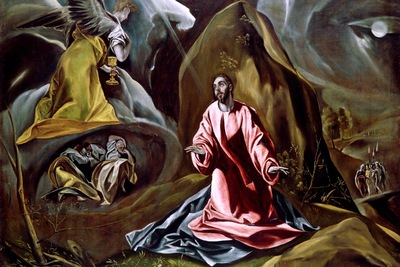
Agony in the Garden
by El Greco
While I do like all the Mysteries, especially the new Luminous Mysteries since there is so much in them to meditate upon, my favorite Mystery is the First Sorrowful Mystery, the Agony in the Garden.  I have always been attracted to the story and paintings of Jesus struggling to accept the will of His Father.  How easily I struggle with doing God's will and feel that God has abandoned me in my suffering.  As I meditate on this Mystery, I put myself in the Garden and I ask Jesus to send angels to support me and ask God to give me strength. I also sense the intense agony that Jesus went through and with Him I can resign myself to accept my meager sufferings and to give them to God, "let it be as your will, not mine would have it."

To those who say the Rosary is simply a rote prayer or boring, the Pope is asking us to use the Rosary to lead us into meditation.  As Mary contemplated the events in the life of her Son, so too we imitate her and ask her to bring us closer to Jesus.

August 15, 2011

The Assumption

window at St. Mary's, Manhasset

I have always found the Solemnity of the Assumption to be a great feast, but it seems that, at least over the past few decades, it has sort of faded into the woodwork,  along with many other great feasts and devotions.  Here in the states, because it falls on a Monday, the obligation to attend Mass is abrogated.  That means that most people won't go to Mass to honor Our Lady and celebrate this unique and beautiful feast, and that is a shame.  While I do have a bit of difficulty in my personal relationship with Our Lady, I do know that she cares very much for me even though I don't give her the attention that I should, but I am working on it.  Even so, when I pray the Rosary (which I do every day) and celebrate feasts like this one, I am reminded that we are called to imitate her in her fiat and in her obedience to the Father.

The readings for today's liturgy are wonderful.  I especially like Luke's Gospel of the Visitation. I used this Gospel in a talk I gave about our Blessed Mother twenty years ago. In it I echoed Elizabeth's question, "How does this happen to me, that the Mother of my Lord should come to me?" Yes, she does come to me, and to each and every one of her children who ask for her protection and her intercession.  Today this Gospel reminded me of that,

I thought for today's feast, I would share John Michael Talbot's version of Mary's Magnificat. It is a beautiful rendition and one that I love to sing and to meditate upon.  

June 23, 2011

A Part of Me Died Today


Today I said good-bye to one of my best friends. I know some people would say, "it's just a dog," but she was such a special part of my life and that of my family.  Nikki came into our lives one May afternoon after I took my youngest daughter to the local shelter to look at the puppies. Theresa was always afraid of dogs and I thought that if she could be near ones in cages or get to touch some she might feel better about dogs.  She instantly fell in love with this skinny scrawny German Shorthair Pointer mix with long skinny shakey legs.  I liked the Labs and other dogs that were jumping around as we came near.  This poor little thing just stood on her wobbly legs, wagged her tail, and kept looking at Theresa.  She begged to have them take her out.  So I did and they placed her on a blanket on the floor with Theresa.  I think it was instant attraction and Theresa didn't want to leave without her.  For some strange reason, even though I had my doubts about this dog, I agreed to adopt her.

Nikki turned out to be the joy of our family for over 12 years. Her scrawny, trembling legs became amazingly strong, and she became an unbelievable jumper.  She hardly ever barked, but my husband taught her to "say" I love you, and very clearly I might add.  She got along beautifully with the cats and she was friendly to anyone she would meet. She was sensitive and loving and part of all family activities. 

Age and several medical complications slowed Nikki down during the past year. She couldn't jump anymore, sometimes could not get onto the bed (she slept by my feet most nights).  The last three months, with the discovery of a growth in her abdomen, her health deteriorated.  She was still active and even as late as last week was pretty active despite frequent emergency visits to the vet because of her health.  Yesterday she was very lethargic, disorientated, and this morning could not even get up.  I knew it was time. It's a difficult decision to make, but it is better than seeing her get worse and suffer more and more.

God brought Nikki into my life during a difficult time. She was my friend, my comforter, she made me smile.  I thank God for the twelve years I had with her.  I think God knew what He was doing when He created dogs.  I know Nikki taught me a lot about God's love. If a lowly dog could show me such unconditional love, how much more is the unconditional Love of God, who IS LOVE?  A few years ago I discovered the following video. I offer it in honor of Nikki.  I will miss you.


May 31, 2011

The Visitation


Today is the Feast of the Visitation. I love this painting by Carl Block, an artist I am not familiar with.  I love this painting because of the excitement that is shown in Elizabeth welcoming Mary and her unborn Son.  Her arms are open wide and it seems as if any moment she will run down the stairs to embrace her cousin and welcome Mary into her home.

This feast, I believe, celebrate hospitality.  As an Benedictine Oblate, hospitality is something that we are called to practice.  St. Benedict teaches to welcome all as if welcoming Christ.  But that is not always easy and as an introvert, it is not always easy for me.  I am being challenged to come out of my own insecurities and to show more hospitality toward others.

I also believe that this is a feast that celebrates women.  There is a special bond between women that I don't think can exist between men.  Social mores allow a certain amount of intimacy and physicality between women that is not usually accepted between men.  Women tend to be more open with other women and more accepting, despite what the TV reality shows would like us to believe.  

I also think that childbirth creates a unique bond.  The fact that women can bring forth life is something that brings all women together, even those who do not have children.  It is something innate, a sense of nurturing and nourishing that is part of our nature as women.  I found this painting online. I don't know the artist, but again it portrays the great joy Elizabeth expresses.  Luke writes on the lips of Elizabeth, "But who am I that the Mother of my Lord should come to me?" We too can ask that same question. Mary comes to us, as a mother, but also as a woman, who shares with us everything that womanhood entails.  Let us welcome her as we welcome her Son.


May 23, 2011

Botticelli and the Nativity


Since I am on a well deserved vacation, my posts will probably be short, but I'll continue exploring art work on the subject of our Blessed Lady. While not specifically focused on Mary, we cannot ignore the images of the nativity. We are so used to seeing the sometimes overly sentimental images we see on Christmas cards that we overlook some of the great paintings that have been created throughout the centuries. The above painting of the birth of Jesus is titled "Mystical Nativity" and was painted by Sandro Botticelli in 1500.  It is full of symbolism, and while it is a depiction of the birth of Jesus it also contains images from Revelation and the second coming. It also contains iconic elements.  


Botticelli was a Florentine artist of the early Renaissance and his work certainly influences some of the great Renaissance artists.  He also painted several images of the "Adoration of the Magi," such as the one above. While he created many religious paintings he is probably most known for his paintings done for villa of Lorenzo de Medici, "The Birth of Venus" and "Primavera" which show his fascination with the Greek mythology.

Just as with many Renaissance artists, Mary was a favorite subject. This painting, "Madonna and Child with Six Saints," is in the Uffizi Gallery in Florence.  From left to right the saints are Mary Magdelene, John the Baptist, Cosmos and Damian, St. Francis and Catherine of Alexandria.

May 20, 2011

Presentation of Mary


Back to Our Lady in art and again I find myself with Giotto, this time for the Presentation of the Virgin in the Temple.  Like the birth of Mary, this account is not found in the Gospels but comes from apocryphal writings and is celebrated by the Catholic and Orthodox Churches.  The story tells that Mary's parents were childless and when they conceived Mary they promised to dedicate her to God.  They brought her to the temple where, the story goes, she remained there until betrothed to Joseph.  Nice story, but in all likelihood there was no such thing as Jewish temple virgins.  First of all, women were not allowed in the temple but had to stay in a courtyard for women. Also I don't believe the temple had living quarters. And, who would take care of dedicated children...temple nannies?  Ok, that was a joke. This story, however, shows us that Mary was set apart to be the Theotokos and Giotto is one of the few artists that portrayed this story in art.

This story also brings up something I have been thinking about for awhile. How many people these days actually consecrate their children to God? Yes, we as Christians baptize our children, which means they are reborn in Christ and anointed to share in His mission. We as Catholic parents, promise to take on the responsibility of bringing up our children in the faith as first teachers of the faith.  How many really take this seriously?  I coordinate the baptism ministry in our parish and in the past 5 years the numbers of baptisms have declined significantly.  No, the number of children being born has not, but parents are not that quick to have their children baptized or they see no problem with baptizing them in another faith.  A growing number of these parents were not married in the Church and when I ask them to come to Mass they give all kinds of excuses as to why that is not really possible.  Most likely the next time we will see some of these children in church is when they begin their preparation for First Holy Communion.

Last week I sent away for my baptismal certificate.  We were discussing our own baptisms at work and I didn't know the date of mine.  When I received my certificate the other day I discovered I was baptized at 3 weeks old on May 16. Three weeks!! My own children's baptisms were about a month to six weeks after birth. Most of our baptisms today are celebrated when the children are over 4 months old with over 6 months being the average. We also see a good number past their toddler years. Now there may be good excuses for delaying baptism, but what does that say about the desire to dedicate children to God, to have them as part of God's family. 

Maybe we need to dedicate our children to God each and every day, no matter how old they may be,. I think I am going to start doing that. Maybe some miracles will happen. Hear that kids?

May 16, 2011

Birth of Mary


I promised I would dedicate much of the month of May to art work depicting the Blessed Mother. So, even though I have already presented a few pieces I thought I would look at Our Lady in chronological order. The above fresco is of the Birth of Mary and was painted by Giotto.  He was an Italian artist of the late 13th early 14th Centuries.  He is known for making the transition from Byzantine and Middle Age art to the early Renaissance.  He is one of the first artists to give his figures a more realistic look and put them in natural poses. He also used colors that had not been used before. In this fresco, he depicts the mid-wives wrapping the infant Mary in swaddling clothes (pictured on the floor by the bed) and then presenting the child to her mother Anne.  The presentation of two figures of the same subject in the same painting looks odd, but was fairly common in the Middle Ages.

What is really interesting about this subject, the birth of Mary, is that it is not Scriptural.  The account of the birth is found in the Protoevangelium of James, an apocryphal gospel, yet it found its way into Catholic and Orthodox tradition, and is attested to from the 4th Century on. The birth of Mary is celebrated on September 8th.

May 8, 2011

Mother's Day

A very blessed and happy Mother's Day to all.  Although Mother's Day is what we would call a "Hallmark holiday," it is a good idea to honor mothers in a special way, at least once a year. After all, our mothers have done so much for us, most importantly, giving birth to us.

Yesterday I was at a joint Oblate meeting at the monestary where I am a Benedictine Oblate, and the topic of the talk given was the sacrificial nature of the Mass.  It was a great talk and something that we all need to be reminded of, and not just focus on the meal aspect.  Someone in the audience brought up the question of Our Blessed Mother's sacrifice.  I am not sure if the presenter really understood the question, and to be honest I was a bit confused as to the connection with the Mass, but I kept thinking about it.  This morning on the way to work, I thought of all the sacrifices that mothers must make for their children, the very first being sacrificing their body and blood to give life to a child.  Our body supports the life that grows within us. Our blood nourishes the growing fetus.  Isn't that what happens when we receive the Eucharist? Christ's Body and Blood supports and nourishes us.  Ok it might be a stretch, but I think it is worth exploring.


You don't find too many renderings of Our Blessed Mother pregnant, aside from paintings of the Visitation or traveling to Bethlehem.  I did however come across this icon.  I thnk of all the sacrifices Mary had to make. A young virgin, not really understanding all that was about to happen to her, she sacrificed her own body and her will in obedience to the Father's will for her.  We are aked to imitate her in her obedience and her fiat, her yes to all that the Father wanted her to do and to be. So too, the God asks us to say yes out of obedience and love. But sacrifice does not mean giving up who we are.  In fact, it means to truly become who we are.  The word sacrifice means "to make holy," and isn't that what God wants of us, to BE HOLY?

Motherhood is a holy thing.  It is a great gift that God gives those women who are blest to become mothers.  On this Mother's Day, as we remember and thank God for the gift of our mothers, let us also remember our Blessed Mother, who teaches us how to be holy, how to obey God's will, and how to sacrifice ourselves for our children.

May 6, 2011

Raphael's Madonnas


One of my favorite artists, and one who especially loved to paint our Blessed Mother, was Raphael Santi.  Raphael was an artist of the high Renaissance and a contemporary (and rival) of Michelangelo. The Madonna seem to be one of his favorite subjects.  One of his most popular is the Madonna of the Chair.  It is painted on a circular piece of wood, which seems to really draw the viewer into the subjects. What I  like best about his paintings are the expressions he puts on the face of his Madonnas.  It is one of peace and tranquility.  

A good number of Raphael's paintings of our Lady show her with Jesus and the young John the Baptist, usually outside in a meadow or in a garden outside a city.  What is striking to me is that the Child Jesus and his cousin are not tiny infants but often toddlers, are usually naked and quite robust.  The other aspect of his compositions that stands out for me is the tenderness of the interactions between Mary and the holy Children.  It is one that any of us who are mothers can easily relate to.  They are very natural and show the true humanity of the Virgin and her Offspring. 

As things have it, I had planned to write about Raphael's paintings and a friend and a classmate of mine from Notre Dame posted this on Facebook yesterday. It includes a number of Raphael's paintings.  He posted it as a tribute to his mother who passed away this year.  I post it in honor of our Lady, in memory of Tom's mom, and for all our mothers.  It is a beautiful composition of Ave Maria by Morten Lauridsen, a contemporary composer.  I hope you enjoy it. I did.

May 5, 2011

Prayer


"Woman in Prayer" by Paul Gauguin
Today is the National Day of Prayer. In 1988 President Reagan signed a bill into law making the first Thursday in May a day for the nation to focus on prayer, whatever their creed. It's a good idea, but honestly I don't think many people know about it.  I didn't know about it until yesterday when I was looking up some information on the internet.  I do find it interesting though that I was planning on publishing this post on prayer today, May 5th, and even more surprizing is that yesterday in Rome, Pope Benedict announced that his weekly audience talks will focus on prayer.  Coincidence?  Hmmm.

What prompted me to write on prayer was that the other day I came across a quote by Thomas Merton that truly touched me.  He wrote, "All true prayer somehow confesses our absolute dependence on God. It is therefore a deep and vital contact with Him...It is when we pray that we really are."  That is a very powerful statement, but can be a confusing one.  Yes, prayer does express our dependence upon God, because often we are asking for something, something we cannot achieve on our own, or for a need that we have.  Our prayers of thanksgiving recognize that God has graced us in some way and we are expressing our gratitude, which is also acknowledging that we are dependent upon Him.  But what about the rest of that quote.


True prayer, in the sense that Merton conveys, I believe goes beyond asking and thanksgiving. What is the purpose of prayer?  I have often been reminded that the ultimate purpose of prayer is communion with God. Pope Benedict stated in his audience yesterday that "expressed in every prayer...is the truth of the human creature, which on the one hand experiences weakness and indigence, and because of this asks help from heaven, and on the other is gifted with extraordinary dignity, as, preparing himself to receive divine Revelation, he discovers himself capable of entering communion with God." It is because of God's gift of faith that we can even approach God in prayer. God wants us to come to Him. He calls to us. 

True prayer goes into the realm of simply being in the presence of the Almighty, realizing that He is the fulfillment of all our desires.  It is what is called "mystical union." Many of the great mystics, like John of the Cross and Teresa of Avila, have written of this union. It is in this communion with God that we become what we are, what we were created to be by God. Eastern Christians call this theosis or divinization, a sharing in the life of the Trinity. St Athanasius, whose feast day we celebrated Monday,    explained theosis as "becoming by grace what God is by nature."  Sort of makes you want to pray, doesn't it?

May 4, 2011

Ora et Labora

Evening Prayer by Jean Francois Millet

One of the venerable prayer traditions of the Church has been praying the Angelus three times daily. It was a way of following monastic tradition of interrupting work with prayer during the course of the day, what we Benedictines call "ora et labora," or prayer and work.  The "ordinary folk," those not bound canonically to pray the Divine Office as the monks, nuns and clergy did, would listen for the church bells at 6 am, noon, and 6 pm, drop what they were doing, and pray the Angelus. There was a time when people took this time for prayer very seriously. Millet expressed this very simply in his painting of two farmers stopping their work in the evening to pray.  Vincent Van Gogh even copied the work in one of his paintings.

Today, many are unfamiliar with this tradition or even the Angelus prayer. Our lives are so busy that we often don't even stop for lunch let alone prayer.  I first learned the Angelus in elementary school where we prayed it as a class at noon.  As an adult, while I didn't pray the prayer, whenever I heard the familiar "bong" eminating from the church steeples at noon, I thought about it, but didn't recall the words.  I did eventually look it up, and after a pilgrimage one year where we prayed it, I tried to pray it every so often.  It wasn't until I entered the doctoral program at our seminary and we joined the seminarians at dinner, did I really begin to pray it regularly. The seminarians began grace before meals with the Angelus, and soon the familiar words to the prayer came back to me.

The one thing I did learn during those dinners at the seminary, that I don't recall learning in elementary school, was that during the Easter Season, from Easter Sunday until Pentecost, the traditional Angelus is not prayed but substituted by the Regina Coeli.  While the Angelus recalls the Annunciation, the Regina Coeli or Queen of Heaven is a beautiful prayer that extols the joy of our Blessed Lady in the Resurrection of her Son.  It is a traditional Easter hymn.

Through the wonders of You Tube I found this rendition of the simple chant version complete with art work (and the English translation).  Perhaps it might encourage us all to remember to stop our work from time to time to offer prayer to the Lord.  May you have continued blessings during this Easter season.

May 2, 2011

Picturing Mary

Since May is the month of Mary, I thought it might be a nice idea to look at some art work depicting Mary througout the centuries.  Of all the human subjects ever used in art, our Blessed Mother is probably the most popular.  Yet if we look at the Marian art most Catholics would have in their homes, I would catagorize it "Catholic kitsch."  What is that, you ask?  It is sort of what you find on holy cards, statuettes, popular renderings, and even some truly outrageous stuff.  I keep saying that one day I am going to start a collection of Catholic kitsch.  If the American Pickers can find buyers and collectors for the stuff they find, think of what I could do in Catholic circles with some of the strange things I've come across. Like the "glow in the dark" Mary.  Or how about this rainbow collection of Marys.  You can have a color for whatever mood you might be in.  I even came across one that had an LED display and it would flash different colors.

Then there are the popular portrayals of Mary that we find on holy cards or receive in the mail with requests for donations.  Usually it is a picture of Our Lady of Grace, Our Lady of Fatima, or the Immaculate Heart of Mary.  While there is nothing wrong with these images, they pale next to the great works of art down through the centuries that show us the depth of Marian devotion. Having studied art, and being Catholic, I am fascinated by the ways Mary has been portrayed, and while I am sure these popular depictions do much to foster people's devotion, I prefer the more classical artistic renderings.

The earliest known depiction of Mary is found on the walls of the Catacomb of Priscilla  in Rome. The paintings found in this catacomb are beautiful. In this wall painting from the beginning of the third century, we see Mary nursing Jesus while a man who appears to be a prophet, points to the star (out of view). It is a reference to the prophesy by Balaam in the book of Numbers 24:17, "A star shall advance from Jacob, and a staff shall rise from Israel."  I find it appropriate that the first painting of Mary is one of her engaging in one of the most motherly things she can do, and that is nourish her Child. The image of Mary as the nursing mother is not as popular as other images, although I have found many beautiful paintings online.  Perhaps the image of Mary with her breast exposed is something some people don't deal with well expecting a greater sense of modesty in a portrayal of Our Lady, yet nursing a child is the most natural, intimate, and beautiful things a woman can do.  

Over 30 years ago, someone gave me a holy card and medal with the image of "Our Lady of the Plentiful Milk and Happy Delivery" from the Shrine of Our Lady of La Leche in St. Augustine, Florida. I was a young nursing mother at the time and this image meant much to me.  Meditating on Our Lady nursing Jesus got me through many sleepless nights with a fussy baby knowing that Mary too comforted her Precious Child at the breast. The medal is still attached to my rosary.

When I made a pilgrimage to Greece several years ago, I purchased a nineteenth century icon of the nursing Madonna.  It was first spotted by one of my fellow pilgrims who wanted it, but once I saw it I knew I had to have it. It originally comes from Crete. It is a rare depction and very precious to me, although I must admit, it has bothered me that the writer of the icon had very little sense of female anatomy.
Throughout this month of Mary, along with other posts, I will comment on some of my favorite works of art depicting our Blessed Mother.

May 1, 2011

A blessed day

Last night I had to run to pick up some things at the supermarket and while waiting on line a special edition of LIFE Magazine caught my eye.  Despite its $13 price tag, I had to purchase it.  So here I was on line with my cake mix, Snapple, a bag of lettuce and the Pope John Paul II edition of LIFE.

I haven't given much thought to the beatification of John Paul II until the last few weeks, although, as holds true for many of us, he was the Pope that I was most familiar with.  I was too young to remember Pius XII, being only 4 when he died.  I do remember watching parts of John XXIII's funeral on television and praying for him in school. However it was only years later that I realized how what he started would change the face of the Church forever.  Paul VI was the first Pope that I really remember, but then it was only knowing that he "changed" the Mass, and that his encyclical Humane Vitae caused much controversy among the adults in the parish where we lived.  I really didn't hear much about him in my high school and college theology classes. His funeral was something that I recall being impressed with.  I do remember the very short pontificate of John Paul I. I was a young newlywed and I remember watching the coverage of the conclave on TV in August of 1978, and seeing the while smoke, and then the new pope emerge on the balcony of St. Peter's, and feeling proud to be Catholic. And sadly, I remember waking up that September morning a month later and being stunned to hear that John Paul I had suddenly died.  Like the rest of the world I was in shock.


Then came Karol Wojtyla. Not being that up on "who's who" in the curia, I had no idea who he was, but his relative youth and his charismatic smile made me feel really good about this new Pope John Paul II.  As I learned his life story, I was amazed that he was an actor, a writer, a philosopher, an athlete, a world traveler, a friend of the youth, as well as a theologian.  I recall thinking how he was going to be a good leader of the church.  As I discovered my second vocation as a lay ecclesial minister, and began my studies in theology, I began reading his encyclicals, exploring what he wrote and said, and following in the media his many trips around the world.  I was not able to see him when he came to New York, but a year before he died, I was able to be in the assembly at one of his Wednesday audiences, and to be close enough as he passed by in the popemobile to see him clearly, and cheered when he recognized our group from the diocese of Rockville Centre.

John Paul II did many things during his pontificate, but most of all he taught us the meaning of suffering.  I wrote a paper on his Apostolic letter Salvifici Doloris - On the Meaning of Human Suffering, and connected it to the writings on suffering by St. Therese of Lisieux.  They both showed us how suffering can be redemptive and meaningful for those with faith.  He also taught us how to die, with dignity and everlasting Love for God.

Above all, John Paul II taught us to rely on God's Mercy and Love. Through his own personal devotion to Divine Mercy, the feast we celebrate today, as revealed through St. Faustina, whom he canonized, he introduced the world to this devotion.  It is quote appropriate that John Paul II is beatified today, the Feast of Divine Mercy for it was six years ago, on the Saturday evening before this feast that he established for the universal church, that John Paul II went home to the Lord.

This Feast of Divine Mercy, which is celebrated on the Second Sunday of Easter, helps us to focus on the forgiveness and reconciliation that Jesus imparts to anyone who approaches His merciful Heart in love and humility, asking for forgiveness of sin.

Blessed John Paul II, pray for us.