Showing posts with label spirituality. Show all posts

July 23, 2013

Nothing More Than Feelings

I have been up since before 3 AM listening to the rain softly falling outside. While it is a nice sound and the breeze was gently blowing in my bedroom window, I do wish I was able to go back to sleep. Prayer was difficult so I just decided to rest in the Lord until I decided to get out of bed at 4:30.  This is probably not good for facing a day of work.

I thought perhaps it is a good time to write a post.  I haven't done so in awhile. Call it writer's block. My journal entries are even brief as of late. I get all these ideas in my head about what to write about, but when it comes time to do it my mind goes blank. It is not that I don't reflect on things, for I do that a lot, but the words just don't make it onto paper, or the screen in this case.

For awhile I have been giving a lot of thought to the concept of feelings. Yesterday I viewed a post on Facebook that again got me reflecting on feelings. Thanks Karla for posting it. It expresses much of what I was thinking about.  I have heard it said, and have also come to the realization on my own, that we put too much emphasis on our feelings. Everything seems to be about how I feel or how I don't feel. Don't say this or that for it might hurt someone's feelings. Feelings are most important, never mind what is the truth. Even within my Catholic circles people are saying that it is all about feelings.  I don't believe that anymore.

I have discovered that feelings can be deceiving and can also keep me from discovering the reality about who I am. I feel hurt by someone, so I shut down, or start feeling sorry for myself. Yet I believe that feelings, positive or negative, can be a starting point for self reflection, for asking the big question, "why do I feel this way?"

When it comes to God, that's where feelings can really get in the way. We often think that God must make us feel good.  Well there are many times when I just don't feel good, when I just don't feel God's presence. This had happened more often in the past few years.  I could have just thought that God has abandoned me, although based on things that have happened in my life I know that He hasn't, but I just don't get those nice feelings with regard to God.  I have come to realize that that's OK. It all comes down to faith.

Faith is not a feeling. My friend Sandy has a favorite Bible quote; "Faith is the confidence in what is hoped for, and the assurance of things not seen." (Heb. 1:1). In 2 Corinthians 5:7, Paul writes, "we walk by faith and not by sight."  For me these passages confirm my thoughts that just as our senses can deceive us with regard to our faith, feelings can as well. Faith is a gift that is available to all who are open to receiving it. Faith gets us though the hard times, even when we feel like all is falling apart, even when our feelings are hurt, or when our feelings are saying that God has abandoned us.

Reading John of the Cross has helped me a lot with regard to relying on senses and feelings when it comes to faith and my relationship with God. When we let go of our desires to "feel good" or to "sense God" and to simply trust in His Love, knowing that He is always with us, that is when we can begin to attain true union with God. And the closer we get to union with God, the more our feelings do not dominate us and our relationships with others. I haven't arrived there yet, but I'm working on it.


July 25, 2012

Finding Spirituality in a Crowd

There is something very good and uplifting about spending several days with close to 2,000 people who are in musical and liturgical ministry in Catholic parishes throughout the country. This week I am at the annual convention of the National Association of Pastoral Musicians in Pittsburgh, PA.  In addition to listening to and singing wonderful liturgical music, there is a spiritual component to the talks and workshops.

So far we have heard two wonderful addresses. The Keynote on Monday was by Fr. Ronald Raab, CSC. He spoke about finding holiness in our suffering and in entering into the suffering of others. Pretty powerful!

Tuesday's Plenum address was given by Fr. J. Michael Joncas, who I had the good fortune to have as a professor when I studied at Notre Dame. I also attended his workshop on the history of the Roman Missal yesterday.  But his talk was like being on retreat. It was about connecting liturgy and life and he used the Gospel Antiphon for Evening Prayer on the feast of Corpus Christi as the jumping off point, connecting it with passages from Sacrosanctum Concilium.  He had me mesmerized. I only hope the talk is made available so that I can reflect on it further.

Tuesday night was an evening of contrasts musically, but both were spiritually uplifting. First a concert of contemporary praise music by young composers and performers. I guess its distinct Catholicity is why we do not hear their songs on Christian radio. Following that was Taize prayer. I have always loved Taize prayer with its meditative chants. It was beautifully to be carried away in prayer by the voices of a few hundred people all singing in harmony while meditating on the cross of Christ surrounded by candles and icons.

This morning we heard another plenum address by Msgr. Kevin Irwin which was challenging but also a warning against making my participation in the liturgy all about me and my wants.  He gave me much to think about.

Right now I am skipping the morning showcases and doing some work on my book.  That would make my publishers, who are in a booth in the conference hall, very happy.

A conference such as this is tiring, and if I decided to do everything on the schedule I would be totally exhausted.  But the time away from work and the mundane things of daily life is good. I have time for prayer (although haven't found my way to a Mass yet as it is a far walk), and the opportunity to connect with some people I haven't seen in awhile and to make new friends, all in an atmosphere where the worship of Jesus is the main topic of conversation.  My voice is a bit hoarse from singing so much and I am walking about 6 miles a day between the hotel and the conference center, but all in all it is a wonderful and inspirational week.

August 19, 2011

Meditation - part I

 My daughter is a licensed acupuncturist and as part of her practice she often encourages patients to engage in some type of meditation. Meditation helps to reduce stress, anxiety and tensions in the body. It also helps clear the mind and allows one to focus better. It has been part of traditional Chinese medicine and Oriental spirituality for thousands of years.  There are many different types of meditation and beginning in the 1960's engaging in some sort of meditation has become very popular in the West.  Yoga and Tai Chi, physical exercises that often produce the same effects as meditation are growing in popularity. Within two miles of my home, I can find several places that offer some sort of meditation or meditative exercise to stressed out people in need of a way to relieve the stresses in their lives, and clear their minds. There are even Catholic retreat centers that offer Zen meditation, Yoga or Tai Chi as part of their spiritual programs, and there are Catholics who have written about the benefits of these practices both physically and spiritually.  But there are other Catholic writers who have warned against them saying that they open those who practice it up to the occult. One has to be careful when dealing with the spiritual life and that our focus always remains with God.

The Church encourages a form of meditation that is often overlooked by those seeking stillness, silence, and a way to connect with God. That practice is prayer.  Too often when people think of prayer they only focus on formal or vocal types of prayer, going to Mass and devotions, praying from prayer books, and reciting rote prayers. A traditional definition of prayer is lifting of our minds and hearts to God. What better way than to sit in silent meditation before Him who created us, and simply BE in His presence.  At his Wednesday audience on August 17, Pope Benedict XVI spoke on the need for meditation and silence in our lives.  In part the Pope said:
"In our own time, we are absorbed with so many activities and commitments, concerns and problems. Often, we tend to fill up all the spaces of the day, without having a moment to stop and reflect and to nourish our spiritual life -- our contact with God. Mary teaches us how necessary it is to find in our days -- with all its activities -- moments to recollect ourselves in silence and to ponder all that the Lord wants to teach us, how He is present and acts in the world and in our life: to be able to stop for a moment and meditate. St. Augustine likens meditation on the mysteries of God to the assimilation of food, and he uses a word that recurs throughout the Christian tradition: "ruminate." The mysteries of God should continually resound within us so that they might become familiar to us, guide our life, and nourish us as happens with the food that is necessary to sustain us. And St. Bonaventure, referring to the words of sacred Scripture, says that they "should always be ruminated on so as to be kept in mind by the ardent application of the soul" 

There are so many ways that we Catholics can practice meditation and once the practice takes root, most find that it produces many of the same physical, psychological effects as other forms of meditation.  The spiritual effects go beyond words. The important thing is to spend the time in silence, invite God in, and let Him take over.  For this to happen, we need to find a quiet place.  For me it is usually in church, or at the beach, or in my summer garden.  In these place I can find the peace and quiet that I need to focus my thoughts and my heart on God.  While it is true that we should always have our Our Lord in our hearts and in our minds, I find that it is through meditation that I make that special connection that allows God to speak to me and to work toward union with Him.  


August 10, 2011

Come to the Water

Peconic Bay from Greenport
One of the great things about living on Long Island is that you are never far from the water, whether it be the Atlantic Ocean, the Long Island Sound, the Great South Bay, or the many inlets, coves, estuaries, and ponds that make up the Island.  I grew up on Long Island and on the water. As a child in Brooklyn (yes it is part of Long Island) I spent summers at Coney Island where both sets of grandparents lived, or on my dad's boat joyfully swimming off the stern or hanging off the bow and we cruised through the bays off Brooklyn.  When we moved to Nassau County  (the "real" Long Island) we actually lived on Reynolds Channel and it was there that I learned to pilot a boat.  We would take trips on dad's boat and when we weren't boating we were down at the beach. Moving to Seaford after I got married found me no more than a mile from the canals and a short 5 mile drive to the beach.  While I don't go boating that often anymore, I do enjoy when we do go out and beach the boat or drift around the bay. I like to kayak, or just sit at the edge of the beach.

Greenport Harbor
So what has all this to do with spirituality? I think a lot. Yesterday my husband and I took a ride to the North Fork, a lovely area of Eastern Long Island filled with vineyards, farm stands, nurseries and quaint little towns. We spent most of the day by the water at Greenport, Orient Point and having lunch on the Sound.  It was a peaceful day and my thoughts turned to the Lord. Jesus loved the water.  Last Sunday's gospel even found Him walking on it.  Wouldn't that be fun! He chose His closest disciples from those who made their living fishing.  Do I know about fishing!  I don't particularly enjoy it, but having lived and live with men who get great enjoyment out of it, I know it takes a certain kind of person since fishing involves planning, preparation, patience, sometimes disappointment, but also a desire for the big haul. No wonder Jesus chose a fisherman to lead the church and used the image of gathering fish to describe those who lead people to Christ.


The beach at Orient and lighthouses at Plum Gut
Orient Point Lighthouse
Jesus also chose water as the means to be re-born in Him.  To me being close to the sea allows me to be closer to Jesus.  Feeling the gentle waves wash over me reminds me of baptism.  But back to Scripture.  Most of the stories of Jesus and water involve trust.  The disciples were afraid of the storms on more than one occasion, and they really didn't trust that Jesus would make it all OK.  No wonder what He admonished them "Oh you of little faith." But upon looking out at the lighthouses in Plum Gut and Orient Point yesterday, I recalled that Christ is our Light. A lighthouse is often used as a contemporary image for Christ, who is the beacon that protects us from crashing against the rocks of destruction and despair and also leads us to the Safe Harbor that He keeps for those who Love Him.

Sometimes we talk about moving off the Island.  It would be nice to live in the mountains or in a small town far away from the city.  But leaving the water would be difficult.  I know God is everywhere but for me, He is present in a special way by the sea.  He is present in all His might in the crashing of the waves. He is present in His gentle touch in the water gently rocking my boat.  He is present in His omnipotence in the vastness of the ocean.  He is present in His Joy as I float and play by the shore.  He is present in His healing ministry as the cool waters cleanse me and refresh me.  And He is present in all His glory in the sun setting over the bay and the full moon rising over the ocean. 

July 21, 2011

Diet and Exercise

My annual medical checkup had been almost two years ago so I thought with summer kind of slow it is a good time to schedule appointments with my various doctors.  This week I had two doctor appointments for physicals, a complete blood workup, an EKG, and a bone density evaluation. Two weeks ago I had a mammogram, and next week I have to go for a sonogram.  So far everything seems fine except for one thing, my cholesterol is 235.  The doctor wants it to be 185. The good thing is that my HDL and triglycerides are good, but I still have to lower that LDL.  She said I need to lose weight (yes, I know that), stop eating animal fats, and get plenty of exercise. Also, to keep my bones healthy she wants me to lift weights and walk.

I took the news in stride, but when I got home I realized that means no burgers on the grill, and the sausage and peppers I made the other night will have to be eaten by someone else.  I'm not a big red meat fan, but the fact that I am now called to avoid it makes me feel deprived. As for exercise, well, I have weights just sitting in the corner of my room, and the 4 mile boardwalk, which is delightful to walk, is only a 10 minute drive away.  I guess it's time to make some changes and pay attention to diet and exercise to keep healthy. The truth is, when I don't pay attention to these things that might not be good for me, my body lets me know its time to start paying attention or pay the price of getting sick. 

This evening while meditating, I was reflecting on what the doctor ordered and started to think about my spiritual health.  My spiritual side also needs an occasional checkup and "diet and exercise" to keep it healthy and to help  me advance toward the goal of union with God. What kind of diet and exercise do I need?  Well, just as what I eat will have an affect my physical health, I have to ask myself what I let enter my soul that I really should be avoiding, and what should I be doing to keep a healthy spiritual life? What is my spiritual diet? The word diet is derived from the Greek word diaita, which means "a way of life." A healthy spirituality means following a way of life that is centered on Christ and on the Sacraments, especially the Eucharist.  Diet also derives from a Latin word dieta, which means "a days work." Being a Christian is work, more often than not. But what is the "work" of a Christian?  The work of a Christian is to continue the mission of Christ in this world, and to follow the will of God in all things. This calls for a steady diet of prayer, scripture, sacraments and avoiding those temptations that lead me to sin and away from God.

So how to we sustain this way of life? Here is where the exercise comes in.  All the great saints have engaged in any number of spiritual exercises.  Prayer is first on the list, in fact for a healthy spiritual life prayer is essential.  How do I pray?  It is simply routine or do I really communicate with God? These are important questions. I  also include some sort of meditation and spiritual reading as part of my daily spiritual exercise.   I know as a Benedictine Oblate I really should be engaging in Lectio Divina daily, but just as I make excuses against going for that walk on the boardwalk, I often find all sorts of excuses not to engage in Lectio. Acts of popular piety are also on the excercise list. Today many people reject some of these acts as old fashioned or not for them, but many traditional acts of piety such as the Rosary, chaplets, time spent in adoration, novenas, and dedication to particular saints, are ways to deepen our spiritual life.  Regular celebration of the Sacrament of Penance and confiding in a spiritual director or a close spiritual friend (in Celtic spirituality this is called anam cara), are good ways of being assured that I am on the right track in my spiritual journey as long as, like with my medical doctors, I give heed to the advice I am given. Having a prayer partner or having a Christian community to pray with helps keep me focused and accountable.

What happens when I don't stick to a diet and exercise routine? I gain weight, feel sluggish and put my body at risk for illness. What happens when I don't stick to a spiritual diet and exercise routine? I don't know about you, but I usually can tell that my life is out of sorts. I don't have enough patience, it seems that things start to go wrong, and I get restless and anxious. It also pulls me away from what I need to do to grow in my relationship with God. In other words, it keeps me from being open to God's Grace. So here we are in mid summer and I have been pointed on a way to good health physically and spiritually.  The important thing is to now stick to it!

July 17, 2011

Taking Another Look at Confession - part I

Over this past week the subject of Confession has caught my attention in several different ways.   On July 24th, the Congregation for Clergy released a document for priests titled "The Priest Minister of Divine Mercy: an Aid for Confessors and Spiritual Directors, which I took the time to read.  Although it was meant for priests, it gave great insight into the Sacrament. In the book I am currently reading,"Rediscover Catholicism" a Spiritual Guide to Living with Passion & Purpose," by Matthew Kelly, I was up to the chapter titled Confession. To go even further, in an online discussion I was engaged in, the conversation centered around the Sacrament of Penance.  Was God trying to tell me something?  It's only been about two weeks since my last confession, so I don't think that was it.  Perphaps God is asking me to write about it. 

I must admit, celebrating the Sacrament of Reconciliation, Penance, or Confession (what ever one cares to call it), is something that has caught my attention over the last twenty years, especially since I began studying theology.  If fact, I chose it as my ad libitum topic for my comprehensive exams at Notre Dame.  I have been fascinated by the history and development of the Sacrament and also the obvious decline in its celebration among Catholics today (although I think we are seeing a slight increase).  I also feel that it is a Sacrament that is much needed in today's world.  But I didn't always feel that way.

As a child I went to Confession every few weeks, but a bad experience with a priest in confession as an adolescent instilled a fear that stayed with me for years (and to some extent still rears its head at times).  I did still go, but over time it went from months to years between confessions. Also, I gave in to the mistaken notion that if I didn't commit a mortal sin then I didn't need to celebrate the Sacrament. That's what it might appear to say in Canon Law, but what I discovered is that my conscience formation was a bit flawed, and I also gave into a bit of relativism (OK maybe more than a bit), so that I had myself convinced that I really wasn't sinning mortally so I didn't need confession. But God was working on convincing me that this Sacrament was necessary, whether I commit mortal sins or not. When I finally came back to Confession after an absense of 9 years, I still did not feel that great about it, but made it a yearly "gotta do" kind of thing, until I started studying theology, reading about the saints, and looking into enriching my own spiritual life.

What I discovered is that this Sacrament is a beautiful encounter with Jesus, who is loving, forgiving and merciful. It is, writes Kelly, "the perfect spiritual practice to rekindle our passion for excellence in the spiriutal life."  What made ordinary people great saints?  I believe it was the realization that they were sinners and that they believed in God's mercy and accepted His Grace, becoming all that God called them be.  Look at some of our most beloved saints, Paul, Augustine, Francis, Ignatius, they all had less than perfect lives before they encountered Christ.  But, in being open to Grace, they confessed their sinful ways, abandoned their way of life, and drew close to God.

Broken Trust
by Natalie Holland
Taking that step to be open to and accepting of God's Grace requires trust. Perhaps that is another reason why I stayed away from the Sacrament for so long, having been hurt, I was unable to allow myself to trust. What I failed to realize however, was that my lack of trust was based on the fault of a human being, not on God. I let one priest, who was unable to be compassionate to an eleven year old girl, influence my relationship with Christ, who is full of compassion. I allowed one man to affect my trust in God. I wonder how many people have let a bad confession experience keep them away from our Lord's forgiveness and mercy? It took me a long time to rebuild that trust by finding good confessors and availing myself of the Sacrament regularly so that I can keep building my trust in God by experiencing His Love and Forgiveness. Have you been away from the Sacrament for awhile, for one reason or another? Why not take another look at Confession!


July 11, 2011

A Blessed Feast Day


Today is the feast of St. Benedict, the 6th century monk who wrote a simple Rule for beginners in the spiritual life that has become the foundation of a rule of life for for religious and lay men and women for over fourteen centuries.  As a Benedictine Oblate I follow the Rule as best I can in everyday life.  The great thing about the Rule is that it really is very simple. It is the way we should be living our lives as Christians and indeed as the human persons God created us to be.

The Holy Rule begins with the word "Listen."  Benedict teaches us to listen to the voice of the Lord in humble obedience. To obey is to hear, to listen, and to act upon what we have heard.  Obedience for Benedict is about Love, that is our loving response to our Loving God.  Obedience is a word that we don't like to hear these days, but the obedience to the Word of God leads to genuine freedom and true happiness.

Benedict also asks us to practice humility and he lists twelve steps to achieve humility. Again this may be a word that many don't like to hear, especially in this day of rampant individualism and the push to get ahead and to achieve the most we can out of life. For some, these twelve steps may seem too hard or too degrading.  But as we read in Scripture "whoever humble themselves shall be exalted" (Lk 14:11).  Practicing the steps of humility leads to recognizing our right relationship with God and with all God's creation.  

One thing that attracted me to the Rule and the Benedictine way of life is that it is very practical, and I am a very practical person.  But it is also very spiritual. Benedictine spirituality focuses on two things "ora et labora;" prayer and work.  Benedictines find God not only in their prayer but in their everyday work, always aware that they are in the presence of the Almighty. Prayer for Benedictines is the Liturgy of the Hours, what we call "Opus Dei," the Work of God, and "Lectio Divina" or Holy Reading.  Along with the celebration of the Eucharist this makes up the prayer life of Benedictines. But work is also a prayer when we dedicate our work to the glory of God. 

Most of all, Benedict calls us "to prefer nothing to the Love of Christ." I have this quote posted on my computer screen at work so that I am reminded everyday to practice the rules of a simple 6th century monk so that I can "set out for the loftier summits...and under God's protection (I) will reach them.

PAX

July 9, 2011

The Beauty of Truth and Charity

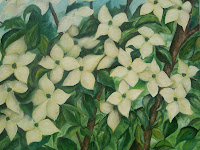
I started out my adult life as an art major.  It's not that I was extremely talented in that area, but it was something I enjoyed, and for a number of years I worked as an art teacher. When the Spirit led me into the world of theology, specifically liturgy, my life's path changed as I focused on new areas to immerse myself.  However, I did find that art and theology went very well together.  Over the years I would dabble in different art and craft forms, but I have always been drawn back to oil painting.  My last attempt had to be eight or nine years ago when I started painting the Kousa Dogwood in front of our house.  I never finished it.  I don't finish a lot of things, which is something I need to explore, but the desire to paint is always there (even if it is just painting the dining room walls).

For awhile now that feeling of wanting to go back to painting has surfaced again. I thought about taking a class on writing icons, which I still might do, but in discovering my unfinished dogwood painting a few weeks ago, I really feel the call to work in oils. I have come across some beautiful photographs of flowers that I thought would be good subject matter, but all of a sudden I felt nudged to paint religious subjects. Over the centuries, religious art was the dominant subject of most art forms, but it seems that aside form the liturgical arts, statues, and architecture, we do't see our faith expressed that much anymore in paintings.  One could say that religious themes don't fit in well with today's modern art, but even as reently as the middle of the last century, artists like Salvatore Dali made religion a focus of much of their art. In fact, Dali's depiction of Christ of St. John of the Cross is one of my favorite works. I have it on a prayer card to mark my place in my journal and I meditate on it often,


Another 20th century modern artist that I am fond of is Georges Rouault. I was introduced to his monumental work Miserere et Guerre when taking a course on Theology and Art at Notre Dame. Rouault created a series of prints that show that when the world suffers, God suffers with us, and that His mercy endures all suffering. If you ever get the opportunity to sees the entire work of 58 prints, you will not be disappointed. 

My point in mentioning these artists is to show that contemporary religious art is possible and it is a shame that we do not see more of it. I was speaking with someone this past Tuesday, July 5th, about my thoughts on painting religious themes.  Call it coincidence or not, but the very next day, I read that Pope Benedict XVI gave an address to artists on July 4th at an exhibit titled The Splendor of Truth, The Beauty of Charity, that was organized in honor of his 60th anniversary of ordination to the priesthood. The following words in the Pope's address spoke to me:

"Dear Friends...never separate artistic creativity from truth and charity; never seek beauty far from truth and charity, but with the richness of your genius, of your creative impulse, be always courageous seekers of truth and witnesses of charity. Make truth shine in your works so that their beauty awakens in the sights and hearts of those who admire them the desire to make their existence, all existence, beautiful and true, enriching it with that treasure that never diminishes, which makes of life a work of art and of every man an extraordinary artist: [the treasure of] charity, love."

Wow, just what I needed to read to encourage me to pick up my brushes.  I went in search of my paint box and lo and behold the tubes of oils are still good.  I even went out and bought some canvases.  So I am ready to begin...but first I have to finish my dogwoods.


July 7, 2011

God is watching us

I was talking with someone the other day about the surveillance cameras that are being installed just about everywhere.  First we just saw the traffic cams that would keep us abreast of traffic jams and accidents as we watched the morning news to judge our commute to work.  But now, these cameras catch us if we try to beat the red light, make a illegal turn and I am sure they soon will catch us if we are speeding.  You can't walk into a store without seeing cameras that were once only common in banks and jewelry shops.  In some areas they are even on the main streets.  More and more schools have them and they are even being installed in churches. Yes, they are for our protection but many people view them as "Big Brother" watching over us.

Then there is this little innovation called "Google Earth"  I love the site.  From a satellite high above the earth it can pinpoint minute details of any place you choose to look at. Granted it is not a live picture, but in looking up my own address, I was amazed at how much was visible from these satellite images. You could practically see that my lawn need mowing (no, that was from the ground level cameras that practically see into my living room).  Once I found a friend's house whose address I did not know, simply by Googling the specific area and zeroing in on landmarks that I saw in a picture she had sent me.  If someone wants to find you, seems there is no place to hide. 

Yes, it seems the government is always watching us, but Someone else is always watching over us as well, noticing our every move, our every step. Someone even knows our thoughts before they come to our consciousness.  However we don't seem so concerned that He sees all and knows all.  For some, the fact that God is ever present and ever watchful is not a deterrent to wrongdoing.  Most people I would assume, are totally oblivious to the fact that God is watching us, and not "from a distance" as Bette Midler would have us think, or as the satellites circling above us in space.  No, our God watches from a place much closer than surveillance cameras can ever get.

Psalm 139 expresses this beautifully.  It is, according to the footnotes in my New American Bible, "A hymnic meditation on God's omnipresence and omniscience."  The psalmist makes me aware that God is with me always, and there is no place where I can hide from Him.  Yes, this should jolt me into making sure that my life is being lived in light of God's commandments, but it above all should give me a sense of security knowing that God's "hand will guide me."  

The fact that God is watching me at all times is comforting, is calming, it gives me hope and it shows me the great depth of His Love. I cannot escape Him, no matter how far I try to run from Him. He finds me, and lets me know the foolishness in trying to flee from His Love, for it is His Love that gives me freedom, His Love that gives me Life.  The fact that God knows my every thought, helps me to trust in Him more and more, to seek His mercy and forgiveness, and to know that my goal in life is to do His Holy Will and I praise Him for I am "fearfully and wonderfully made."

"Probe me, God, know my heart;
   try me, know my concerns.
See if my way is crooked,
  then lead me in the ancient paths." (Psalm 139: 23-24)


June 26, 2011

Behold what you are, become what you receive.

Today the Church celebrates the Solemnity of the Body and Blood of Christ. We celebrate the great gift that Jesus gives us in sharing His own Body and His own Blood in the Sacrament of the Eucharist.  Unfortunatly in our day, this Gift is becoming increasingly unappreciated.  My docotral project was on the effects of the consumer culture on preparation for First Holy Communion, but it can also be extended to the way many Catholics view the Eucharist.  In my experience, many see it as something they "get" when they come to Mass, and some don't even believe it is the Body and Blood of Christ. I wrote, "The Eucharist is viewed more as a commoditiy rather than an avenue of grace and encounter with God."  Yes, the Eucharist is an encounter, the greatest encounter we can have with Jesus our Lord.  

I thought today I would share with you some of my favorite quotes about the Eucharist.

In today's Office of Readings, we read from St. Thomas Aquinas:
"Since it was the will of God’s only-begotten Son that men should share in his divinity, he assumed our nature in order that by becoming man he might make men gods. Moreover, when he took our flesh he dedicated the whole of its substance to our salvation. He offered his body to God the Father on the altar of the cross as a sacrifice for our reconciliation. He shed his blood for our ransom and purification, so that we might be redeemed from our wretched state of bondage and cleansed from all sin. But to ensure that the memory of so great a gift would abide with us for ever, he left his body as food and his blood as drink for the faithful to consume in the form of bread and wine."

St Augustine:
"You, however, are the Body of Christ and His members. If, therefore, you are the Body of Christ and His members, your mystery is presented at the table of the Lord, you receive your mystery. To that which you are, you answer: `Amen'; and by answering, you subscribe to it. For you hear: `The Body of Christ!' and you answer: `Amen!' Be a member of Christ's Body, so that your `Amen' may be the truth."

Blessed Tersa of Calcutta:
"In each of our lives Jesus comes as the Bread of Life - to be eaten, to be consumed by us. This is how He loves us. Then Jesus comes in our human life as the hungry one, the other, hoping to be fed with the Bread of our life, our hearts by loving, and our hands by serving. In loving and serving, we prove that we have been created in the likeness of God, for God is Love and when we love we are like God.
St. John Chrysostom:
"How many of you say: I should like to see His face, His garments, His shoes. You do see Him, you touch Him, you eat Him. He gives Himself to you, not only that you may see Him, but also to be your food and nourishment."

Blessed Pope John Paul II:
"The Eucharist is the heart of the Church. Where Eucharistic life flourishes, there the life of the church will blossom."

Pope Benedict XVI:
The Eucharist is a 'mystery of faith' par excellence; 'the sum and summary of our faith.' The Church's faith is essentially a eucharistic faith, and it is especially nourished at the table of the Eucharist."

There are so many more I could print here. In my own words, the Eucharist is what gives me strength.  Just as food and drink give me the nourishment my body needs, so too the Eucharist nourishes my soul.  As we celebrate this beautiful solemnity, it is good to focus on your own beliefs and feelings about the Eucharist, and how important it is to your own life.

I end with my favorite quote on the Eucharist.  St. Augustine said, "Behold what you are, become what you receive."  This quote literally changed my life. When I receive the sacred host in my palm, I have the opportunity, for a brief moment, to literaly "behold" my Lord and Savior. When I receive Him into my body, I become "the Body of Christ."  As they say, "You are what you eat!"


June 21, 2011

Happy Summer


Summer is here and this is where I will be spending a lot of my evenings - the boardwalk at Jones Beach.  I am not particularly a beach person. I don't like sand and I don't like crowds. Jones Beach is a popular spot and gets very crowded in the heat of a summer's day.  But night time at the beach is different.  The boardwalk is two miles long a filled with lots of excitement.  I like to go down after dinner and walk, usually by myself.  It is a good place to pray and to reflect on the beauty of God's creation.

I have always liked boardwalks. As a child, both sets of grandparents lived in Coney Island, and I fondly remember spending hours "under the boardwalk" getting relief from the heat. That was at a time when under the boardwalk was a safe place to hang out.  When we moved to Long Island, we lived within walking distance to the beach, and many a summer night was spent riding my bicylcle with my mother on the Atlantic Beach boardwalk.  My elementary school was located across the street from the Long Beach boardwalk.

But the Jones Beach boardwalk is special.  There are spots on it that are busy and crowded, but other areas that are quiet and out of the way. God has spoken to me vey clearly many times during my evening walks. Once He surprized me with a bush full of Monarch butterflies when I was feeling a bit low.  Other times I heard His voice in the sound of the waves crashing against the shore, reminding me that His Love is as constant as the rising and falling of the tides.  A number of times he has blown me away by the awesome beauty of the full moon rising over the Atlantic Ocean.

If the sun hasn't set, I sometimes walk down to the water and watch the sandpipers running across the damp sand, or hermit crabs carrying their houses.  While there are not a lot of shells, every once and awhile I do find a real beauty.  God's presence is all around me at the beach in the evening. I feel Him in the cool breeze, in laughter of children as they get their last chance to put their feet in the water before they close the beach for the night, and in couples snuggled together wrapped in a blanket sitting on water's edge.  Back on the boardwalk I could stop to listen to music at the bandshell or, if the wind is right, hear the sounds coming from Jones Beach theatre.  People watchng is always fun.  The cultural diversity of the people on the boardwalk helps me to see that God is in all people.  Everyone is happy on the boardwalk.  You can have an icecream, a cool drink, play volleyball, shuffleboard or miniature golf, or join in square dancing or line dancing.

The boardwalk is a place to relax and be renewed after a day's work.  I feel that is why God made beaches and why He inspired people to build boardwalks.  If you have the time, come down to Jones Beach one night.  Maybe I'll see you there.

June 19, 2011

Trinity Sunday

Today we celebrate Trinity Sunday. It is one of those feasts that celebrates one of the central dogmas of our faith, that is that God is a Trinity of three Persons who exist as one God.  This is a mystery that is almost impossible to explain and even harder to understand.  Thoughout the centuries, theologians have tried to explain it using symbols.  St. Patrick is noted for using the shamrock or three leaf clover to explain the Trinity. The three sections of leaves on the plant are each distinct but together they make up one leaf. 

 
The ancient Book of Kells from the early 9th Century illustrates the Trinity in what is popularly called the Celtic Knot. It is interesting that this has become popular with young people for whom this has become an often requested tatoo image.  I often wonder if the significance of the image is known or if it is just chosen to express their Irish heritage.

My favorite depiction of the Trinity is Rublev's 15th Century icon of the Trinity. It written as a depiction of the angels visit to Abraham from the Book of Genesis, but it is full of  Trinitarian symbolism. If you click the link you will be able to navigate around the images of the icon to learn their meaning.  This is why I love icons, they are so rich in symbolic meaning.

So what does the Trinity mean to me? My favorite way to enter into the mystery of the Trinity is with the word "perichoresis."  It is a Greek word that literally means "to dance around;" peri meaning "to circle" and choresis meaning "dance" (the root of the word choreography).  It is a word that was first used by the early Church Fathers, Basil the Great, Gregory of Nyssea, Gregory of Nazianizus and John of Damascus to describe the relationship of the Father, Son and Spirit. St. John wrote, “The subsistences [i.e., the three Persons] dwell and are established firmly in one another. For they are inseparable and cannot part from one another, but keep to their separate courses within one another, without coalescing or mingling, but cleaving to each other. For the Son is in the Father and the Spirit: and the Spirit in the Father and the Son: and the Father in the Son and the Spirit, but there is no coalescence or commingling or confusion. And there is one and the same motion: for there is one impulse and one motion of the three subsistences, which is not to be observed in any created nature” (The Orthodox Faith, 1.14).


I do like  the image of a dance.  If you look at dancers, and I am not talking about what you see on "So You Think You Can Dance," or "Dancing with the Stars" or other such TV shows, but real ballroom dancing, the Fred Astaire and Ginger Rogers sort of dancing. The dancers are individual persons, each having their own distinct movements and costumes, but together they create something beautiful and cohesive.  You cannot have someone ballroom dance alone.  It just cannot be done. So too with the Trinity.  The Trinity is a Communio Personarum, a community of Persons who move and flow and draw life from one another in a "Great Dance" of Love. 

The Celtic Knot seems to illustrate this concept, but in a static sense. However, the Love of the Trinity is always moving, like the dance. The best part of this Dance is that God is always drawing us into it. God wants us to be part of Him.  We make the choice to "sit it out" or to accept the invitation to join in the Dance, to be gathered into the very Life of the Trinity for ever.

Glory to the Father, and to the Son, and to the Holy Spirit, as it was in the beginning, is now and will be forever.

June 16, 2011

Look at the birds in the sky...


We have a new family that moved in under the eaves by our front door.  As so happened, momma and pappa bird began in early spring making a nest in the light fixture over the front door.  Not wanting to see a fire, we kept removing the nesting material, but these tenacious birds kept coming back. Finally we put a screen over the opening, but still they kept trying to get in. My husband decided to hang a birdhouse close to the door and, lo and behold, they made it their home.  A few weeks ago we heard the small sound of baby birds, and momma and pappa began their feeding runs.  There are three little hatchlings whose open mouths are all we see of them.

It is amazing to watch. Momma and Pappa are very wary of our cat, Jake, who sits on the front porch, and they squawk and squeal to keep him away.  They even make noise to keep away human visitors, although if I sit quietly on the porch long enough they will begin their feeding routine with me sitting only a few feet away.  It is beautiful to watch, although not so great to hear at 4:30 in the morning when they awake.

The great thing is that it shows me that God does provide for all God's creatures.  As Jesus said in Matthew 6, "Look at the birds in the sky. They do not sow or reap, they gather nothing into barns, yet your Heavenly Father feeds them. Are you not more important than they?"  The birds are very happy in their little home, protected from the elements. God provides them with worms and bugs and somtimes pieces of bread that they bring over to their brood. 

It also shows me that God will always provide for my needs. I may not always have everything I want, but, if I truly trust in God, then I will have all I need...my faith, the Love of the Lord, a community to pray with, and the Eucharist that nourishes me with the very Life of God.  What more do I need?  As St. Ignatius wrote, "Give me only your Love and your Grace. That is enough for me."

June 7, 2011

Tending your garden

It always takes some adjusting when one gets home from vacation. Yes the time away is enjoyable and good, but then we have to come back to reality with its schedules, deadlines, and other responsibilities. I am trying not to let coming back to home and work be too stressful.  I have come to discover that giving into stressful situations is one of my faults which I am working hard to overcome, hence the title of this blog and the scripture passage from where it comes.

One of the things I am doing in the few days I have been back in New York is tending my garden.  I have made a few trips to the nursery and The Home Depot and have been planting flowers around the yard and on the deck. Flowers make me happy.  I don't have a green thumb so it may not look like a botanical garden, but as I sit outside in the morning to say my prayers, with a cup of coffee and the sound of the birds chirping in the tress, I feel at peace and at one with nature and with the Creator of all that is beautiful and good.

It's early in the season and my plants are still small, but soon they will grow and the yard will be filled with color.  I kind of think our spiritual life is like that.  We start out "small," like a seed or seedling, and the more nourishment we get through our relationship with God, the more we grow in our spiritual life.  It reminds me of the inquirers in RCIA.  They start out not knowing that much but have a desire for God and to grow in their love of God. We nourish them with God's Word and help them to understand what it means to be a Christian. By the time Easter comes they are "blossoming" and hopefully will continue to bloom throughout their lives. 

The image of a well tended garden to describe the spiritual life is one that has been used throughout the centuries. Jesus himself used the image in His parables of the Sower and the Seed, and when He spoke of trees giving fruit. St. Teresa used the image of watering a garden to describe advancing in one's prayer life.  Along with water, a garden needs sun.  So too, we need the Son. Just as flowers lean toward the sunlight, we must follow the Son where He leads us.  Only in this way can we expect to blossom in the spiritual life.