Showing posts with label Pope Benedict. Show all posts

August 31, 2011

A doorway to the infinite


Pope Benedict XVI,  in his Wednesday audience today, spoke about experiencing God through works of Art.  The full text is not available yet but Catholic New Service posted excerpts of his remarks. The Pope said, "Art is like an open doorway to the infinite, toward a beauty and truth that go beyond everyday reality." I have always felt this way about art. Back in July, I commented on the Pope's address to artists.  The Church has always been a patron of the arts, and as an artist I am encouraged in my craft by the Pope's words.  After reading the Pope's address in July, I mentioned that I was going to pick up my brushes again. After a ten year hiatius, I found that my former way of painting was too stiff and that I was a bit too realistic for my current liking.  Urged on by my son, himself an artist and craftsman, I decided to get a bit more creative with my old unfinished dogwoods.  I was also encouraged by a book recommended by Elizabeth Scalia over at The Anchoress. The book, The Artist's Rule: Nurturing Your Creative Soul with Monastic Wisdom by Christine Valters Paintner, caught my interest because she blends Benedictine spirituality with the practice of one's craft, perfect for an artist who is also an oblate.  I have only just begun reading it, but already I feel it will inspire me to keep on with my painting, and I will have plenty of time to do that while recovering from my upcoming surgery.

The Pope, when refering to art, includes not only the graphic arts but music, writing and dance as well.  I humbly admit that I am involved in the first two of those artistic endeavors, and while I was in the modern dance club in college, my dancing now is limited to the occasional wedding or dinner dance. Music is one of my favorite but lately neglected passions. Next to the study of theology, I love music. I have a favorite quote of Martin Luther who said,
"I am strongly persuaded that after theology, there is no art that can be place on a level with music, for besides theology, music is the only art capable of affording peace and joy to the heart."
Luther had a lot to do with introducing vernacular hymns into the liturgy for he knew the spiritual power of song, and many time honored and beautiful hymns were composed by Lutherans.  Perhaps music can become one of the vehicles for reconciliation and hopefully someday unity. 

Song of Songs III by Marc Chagall
The beauty and the "theology" of art extends beyond creedal differences. This was made clear in the Pope's reflections when he praised the work of Marc Chagall and Bach.  These artists, through graphic art and music respectively, were able to lift the mind and heart to God. Many other non-Cathoic artists have done the same. Even those artists that whose subjects or themes are not religious, can through the beauty of their work, draw their viewers into meditating on the beauty of the Almighty. The Orthodox refer to icons and theology in color.  Good art, especially religious art, can also be theology in color, in notes, in words, in movement and in drama. It can tell a story, but can also can "open the mind's eye and one's heart, pushing us upward."

I look forward to reading the complete text as soon as it is available, and to continue to produce art for the glory of God.


August 22, 2011

True Humility


Detail of Ghent Altarpiece by Jan van Eyck

On Saturday I heard an interesting quote during the homily at Mass. "Humility is a strange virtue. You lose it the moment you think you have it." The priest was preaching on the last line of Saturday's Gospel which states, " Whoever exalts himself will be humbled; but whoever humbles himself will be exalted” (Mt. 23:12). It is a bit of a paradox, for how do you humble yourself without being aware that you are being humble?

I have been reflecting upon the virtue of humility for quite awhile now. It is something that we as Christians should strive for, and certainly as a Benedictine, humility is a virtue that I should be assimilating into my life.  In the Holy Rule, Father Benedict writes:
"Accordingly, if we want to reach the highest summit of humility, if we desire to attain speedily that exaltation in heaven to which we climb by the humility of this present life, then by our ascending actions we must set up that ladder on which Jacob in a dream saw "angels descending and ascending" (Gen 28:12). Without a doubt, this descent and ascent can signify only that we descend by exaltation and ascend by humility. Now the ladder erected is our life on earth, and if we humble our heart God will raise it to heaven."
True humility comes with knowing who we are before God and in our complete dependence upon Him, being always aware of His presence.  True humility also comes with  obedience to the will of God.  Both require trust and turning over our will to our Creator.  This doesn't come easy. I know it is difficult to not desire recognition or not feel pride in a job well done. Then there is the distinction between real humility and false humility.  Being humble does not mean that we let people walk all over us, or that we constantly put ourselves down. That is false humility.  True humility I think is attained when we be who God wants us to be.

Today we celebrate the memorial of the Queenship of Mary.  Mary is the perfect example of true humility.  We hear her humility reflected in her Magnificat:
 My soul proclaims the greatness of the Lord;
 My spirit rejoices in God my Savior.
 For he has looked upon His handmaid’s lowliness;
 Behold, from now on will all ages call me blessed.
 The Mighty One has done great things for me,
 And Holy is His name.
Mary unconditionally accepted the will of God and by virtue of her humility and by virtue of her Love and obedience to God, she was crowned as Queen of Heaven and of earth.  We are called to imitate Mary in all her virtues but especially in her humility. To be humble is to "prefer nothing to the Love of Christ", to put all my trust in God and to proclaim His praises in all that I am and all that I do.

Pope Benedict XVI beautifully expressed following Mary's way of humilty in a homily addressed to the youth of Loreto in September of 2007.
        …the way of humility is not the way of renunciation but that of courage. It is not the result of a defeat but the result of a victory of love over selfishness and of grace over sin. In following Christ and imitating Mary, we must have the courage of humility; we must entrust ourselves humbly to the Lord, because only in this way will we be able to become docile instruments in his hands and allow him to do great things in us.


August 20, 2011

Mediation - Part III

The Rosary


Continuing on Pope Benedict's reflections on meditation from his Wednesday audience:
"Mary teaches us how necessary it is to find in our days -- with all their activities -- moments to recollect ourselves in silence and to ponder all that the Lord wants to teach us, how He is present and acts in the world and in our life: to be able to stop for a moment and meditate...
The holy rosary is also a prayer of meditation: In repeating the Hail Mary we are invited to think back and to reflect upon the mystery we have announced."
If one has difficulty with meditation, or has never really engaged in it, the Rosary is a good place to begin to learn to practice the art of meditation.  When we pray the Rosary, we meditate on the mysteries of the life of Christ.  Yet so often I hear people praying the Rosary at rapid speed and wonder how they can ponder the mysteries or even reflect upon what God might be saying to them as they pray? I wrote in a previous post that I did get impatient with the way people were praying the Rosary after Mass, and I later recalled that St. Therese got annoyed at the way one of her sisters would bang her beads on the pew.  I am far from being a saint so I still have a long way to go offer it to God as Therese did.  I hope the ladies receive many graces through their race to get through it.  I am also not saying that I always pray the Rosary immersed in meditation.  Sometimes I forget what mystery I am up to, telling me that I am not really paying attention nor putting my heart into prayer.

But there are times, I like to think more often than not, when I do allow the repetition of the Hail Mary, Our Father, and Glory Be to act as a sort of mantra that keeps me focused on the mysteries.  I like to pray the Rosary slowly and often in silence. That is why I usually can't pray it with a group like the one I mentioned, as their speed and their loudness would distract me. Praying the Rosary in a group that prays it meditatively however, is often better than praying it alone.  I have experienced this on pilgrimages and in prayer groups that I once belonged to.  The many voices become as one, as if part of a choir.  The softness of the prayers and sometimes singing in between the mysteries, allows for greater meditation and focus on Christ.

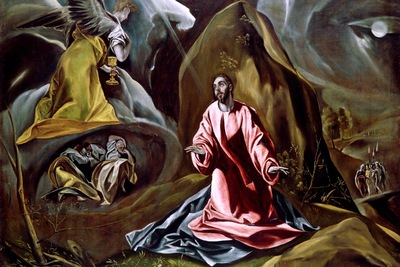
Agony in the Garden
by El Greco
While I do like all the Mysteries, especially the new Luminous Mysteries since there is so much in them to meditate upon, my favorite Mystery is the First Sorrowful Mystery, the Agony in the Garden.  I have always been attracted to the story and paintings of Jesus struggling to accept the will of His Father.  How easily I struggle with doing God's will and feel that God has abandoned me in my suffering.  As I meditate on this Mystery, I put myself in the Garden and I ask Jesus to send angels to support me and ask God to give me strength. I also sense the intense agony that Jesus went through and with Him I can resign myself to accept my meager sufferings and to give them to God, "let it be as your will, not mine would have it."

To those who say the Rosary is simply a rote prayer or boring, the Pope is asking us to use the Rosary to lead us into meditation.  As Mary contemplated the events in the life of her Son, so too we imitate her and ask her to bring us closer to Jesus.

August 19, 2011

Meditation - Part II

Lectio Divina.

Continuing with the Pope's reflections on meditation on August 17, he said:
"To meditate therefore means to create within ourselves an atmosphere of recollection, of interior silence, so as to reflect upon and assimilate the mysteries of our faith, and all that God is doing in us -- and not only the things that come and go. We can "ruminate" in many ways; for instance, by taking a short passage of sacred Scripture, especially the Gospels, the Acts of the Apostles, the Apostle's Letters, or a page from a spiritual author we are drawn to and which makes the reality of God in our today more present, perhaps taking advice from a confessor or spiritual director; by reading and reflecting on what we've just read, pausing to consider it, seeking to understand it, to understand what it says to me, what it says today -- to open our soul to all that the Lord wants to say to us and teach us."
Monk Reading
by Rembrandt
One of the disciplines that Benedictines, and certainly other religious and laity engage in is Lectio Divina or sacred reading.  It is an essential part of their prayer life. This is what the Pope is speaking about.  Lectio is an ancient approach to prayer that involves four stages:
     Lectio - slow and prayerful reading of a passage
     Meditatio - meditating on the passage
     Oratio- praying with the passage, asking God to speak to you through the words
     Contemplatio - allowing God to speak in the silence

Lectio Divina is best when using scripture but it can be practiced using other spiritual authors as the Pope suggests.  I usually reflect on one of the readings of the day for Mass, but I have also used passages from the Office of Readings or from spiritual books I am reading.  In my two year journey with John of the Cross, I often engaged in Lectio Divina using the writings and poetry of this great mystical doctor.

The first step, lectio, involves choosing a passage and reading it slowing a few times. Some suggest that reading it out loud is beneficial. The second step is meditatio.  We take the passage and "ruminate" on the words.  The suggestion I have been given is to "ponder and mull" the words on the page.  This can't be rushed.  Sometimes it takes about fifteen minutes, but other times it has taken me days to meditate on a passage.

What do I like about Lectio Divina?  First, it forces me to be still and silent.  It is difficult to focus and meditate with all the noise that surrounds us each day and the time I spend in sacred reading quiets the noise and brings me to a quiet place. Second, I become immersed in what I am reading, whether it be scripture or other spiritual reading.  It is different than reading for pleasure, or entertainment, or for academic purposes.  Third, the words speak to me personally. In reading and in meditating upon them I come to know God. Fourth, it is truly prayer.  Prayer is lifting of the mind and heart to God, and in sacred reading both the mind and heart are fully engaged in speaking to and listening to God. Finally, in the stillness and silence, I discover what God is telling me through the passage as I simply sit and listen.  This final step, contemplation, is completely in the hands of God.  It is in this step where the stresses and concerns of the day fade into the background and my body relaxes in God's gentle caress.

Meditation - part I

 My daughter is a licensed acupuncturist and as part of her practice she often encourages patients to engage in some type of meditation. Meditation helps to reduce stress, anxiety and tensions in the body. It also helps clear the mind and allows one to focus better. It has been part of traditional Chinese medicine and Oriental spirituality for thousands of years.  There are many different types of meditation and beginning in the 1960's engaging in some sort of meditation has become very popular in the West.  Yoga and Tai Chi, physical exercises that often produce the same effects as meditation are growing in popularity. Within two miles of my home, I can find several places that offer some sort of meditation or meditative exercise to stressed out people in need of a way to relieve the stresses in their lives, and clear their minds. There are even Catholic retreat centers that offer Zen meditation, Yoga or Tai Chi as part of their spiritual programs, and there are Catholics who have written about the benefits of these practices both physically and spiritually.  But there are other Catholic writers who have warned against them saying that they open those who practice it up to the occult. One has to be careful when dealing with the spiritual life and that our focus always remains with God.

The Church encourages a form of meditation that is often overlooked by those seeking stillness, silence, and a way to connect with God. That practice is prayer.  Too often when people think of prayer they only focus on formal or vocal types of prayer, going to Mass and devotions, praying from prayer books, and reciting rote prayers. A traditional definition of prayer is lifting of our minds and hearts to God. What better way than to sit in silent meditation before Him who created us, and simply BE in His presence.  At his Wednesday audience on August 17, Pope Benedict XVI spoke on the need for meditation and silence in our lives.  In part the Pope said:
"In our own time, we are absorbed with so many activities and commitments, concerns and problems. Often, we tend to fill up all the spaces of the day, without having a moment to stop and reflect and to nourish our spiritual life -- our contact with God. Mary teaches us how necessary it is to find in our days -- with all its activities -- moments to recollect ourselves in silence and to ponder all that the Lord wants to teach us, how He is present and acts in the world and in our life: to be able to stop for a moment and meditate. St. Augustine likens meditation on the mysteries of God to the assimilation of food, and he uses a word that recurs throughout the Christian tradition: "ruminate." The mysteries of God should continually resound within us so that they might become familiar to us, guide our life, and nourish us as happens with the food that is necessary to sustain us. And St. Bonaventure, referring to the words of sacred Scripture, says that they "should always be ruminated on so as to be kept in mind by the ardent application of the soul" 

There are so many ways that we Catholics can practice meditation and once the practice takes root, most find that it produces many of the same physical, psychological effects as other forms of meditation.  The spiritual effects go beyond words. The important thing is to spend the time in silence, invite God in, and let Him take over.  For this to happen, we need to find a quiet place.  For me it is usually in church, or at the beach, or in my summer garden.  In these place I can find the peace and quiet that I need to focus my thoughts and my heart on God.  While it is true that we should always have our Our Lord in our hearts and in our minds, I find that it is through meditation that I make that special connection that allows God to speak to me and to work toward union with Him.